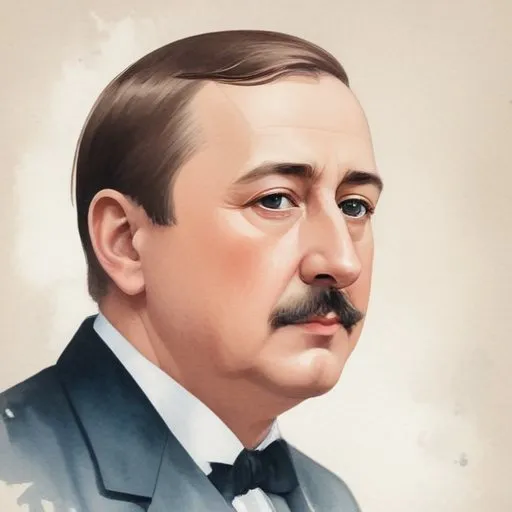
Alexander Borodin: The Renaissance Man of Music and Chemistry
A Synthesis of Music and Science
Alexander Borodin, a Russian composer and chemist, is best known for his symphonies, string quartets, and opera
Prince Igor, which showcase his unique ability to blend Russian folk melodies with classical music. As a doctor and chemist by profession, Borodin made significant contributions to organic chemistry, including the discovery of the aldol reaction and nucleophilic substitution, earning him a lasting impact in both the musical and scientific communities.
Early Life and Education
Born on November 12, 1833, in Saint Petersburg, Russia, Borodin was the illegitimate son of a 62-year-old Georgian nobleman, Luka Stepanovich Gedevanishvili, and a 25-year-old Russian woman, Evdokia Konstantinovna Antonova. Despite the circumstances of his birth, Borodin's biological father provided for his education, emancipating him from serfdom at the age of seven. He went on to study medicine at the Medico-Surgical Academy in Saint Petersburg, where he earned his doctorate in 1858.
Musical Contributions
- In the Steppes of Central Asia, a symphonic poem that showcases Borodin's ability to evoke the vast expanses and rich cultural heritage of Russia's Asian territories.
- Prince Igor, an opera that tells the story of the 12th-century prince Igor of Kiev and features some of Borodin's most memorable melodies.
- Two string quartets, which are considered some of the most beautiful and expressive works in the classical music repertoire.
Chemical Contributions
- The discovery of the aldol reaction, a crucial process in organic synthesis that allows for the creation of complex molecules.
- The codiscovery of nucleophilic substitution, a fundamental concept in organic chemistry that has far-reaching implications for the development of new compounds.
A Champion of Education
Borodin was a passionate advocate for education and women's rights. In 1872, he founded the School of Medicine for Women in Saint Petersburg, where he taught until 1885. This institution provided women with access to medical education, paving the way for future generations of female doctors and scientists.
Legacy
Alexander Borodin's impact on both music and chemistry is immeasurable. His contributions to organic synthesis and his beautiful, evocative compositions have left a lasting legacy that continues to inspire artists and scientists today. Despite his untimely death on February 27, 1887, Borodin's work remains a testament to the power of creativity and the human spirit.
Quotes and Memorable Sayings
"Music is the mediator between the spiritual and the sensual life." - Alexander Borodin
This quote captures the essence of Borodin's artistic vision, which sought to bridge the gap between the intellectual and emotional aspects of human experience.
FAQ
What is Alexander Borodins significance in the history of Russian music?
Alexander Borodin was a leading figure in the Russian nationalist movement, known for his romantic and expressive compositions that drew on Russian folk music traditions.
What is Alexander Borodins most famous composition?
Alexander Borodins most famous composition is the Polovtsian Dances from his opera Prince Igor, which has become a beloved classic of Russian music.
How did Alexander Borodins work impact the development of Russian opera?
Alexander Borodins operas helped to establish Russia as a major center of opera production, and paved the way for later composers such as Modest Mussorgsky and Nikolai Rimsky-Korsakov.
What was Alexander Borodins role in the Russian Academy of Sciences?
Alexander Borodin was a member of the Russian Academy of Sciences and made significant contributions to the fields of chemistry and medicine, in addition to his work as a composer.
What is Alexander Borodins legacy in the history of classical music?
Alexander Borodin is remembered as one of the most important Russian composers of the 19th century, known for his melodic gift, his mastery of orchestration, and his contribution to the development of Russian national identity.