


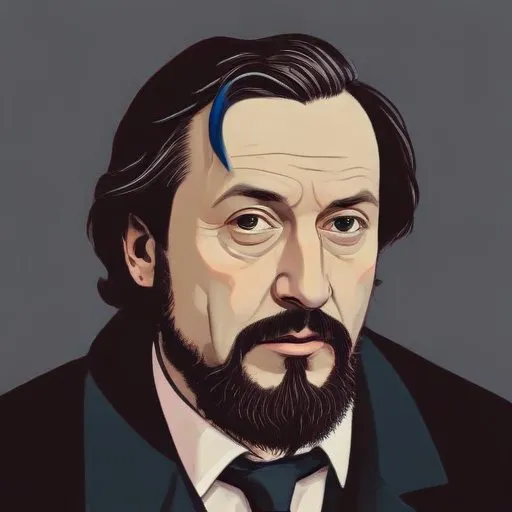
A Russian philosopher and author who wrote influential works on socialism, revolution, and the human condition, known for his autobiography "My Past and Thoughts".
Known as the precursor of Russian socialism and one of the main precursors of agrarian populism, Alexander Herzen was a Russian writer and thinker who left an indelible mark on the country's political climate. Through his writings, composed mainly during his exile in London, he influenced the situation in Russia, contributing to the emancipation of the serfs in 1861.
Herzen was born on April 6, 1812, in Moscow, Russia, to Ivan Yakovlev, a rich Russian landowner, and Henriette Wilhelmina Luisa Haag from Stuttgart. His father, who gave him the surname Herzen, meaning "heart" in German, acknowledged him as his own. Herzen's early life was marked by turmoil, with Napoleon's invasion of Russia and brief occupation of Moscow shortly after his birth.
Herzen's literary career was marked by his passion for social justice and reform. His novel, Who is to Blame?, written between 1845 and 1846, is considered one of the most important social novels of the time. His autobiography, My Past and Thoughts, written between 1852 and 1870, is often regarded as one of the best examples of the genre in Russian literature.
In 1847, Herzen was exiled to London, where he continued to write and influence the political climate in Russia. His writings, particularly in his publication, The Bell, played a significant role in shaping public opinion and contributing to the emancipation of the serfs in 1861.
Herzen's philosophical contributions were centered around his belief in agrarian populism, which emphasized the importance of the peasants and the role of the state in promoting social justice. He was a strong advocate for the abolition of serfdom and the establishment of a more just and equal society.
Herzen's legacy extends far beyond his own lifetime. His influence can be seen in the development of Russian socialism and agrarian populism, and his writings continue to inspire social reform and justice movements around the world.
As a thinker, writer, and social reformer, Alexander Herzen's contributions to Russian literature and politics are immeasurable. His commitment to social justice and his passion for reform continue to inspire generations, making him one of the most important figures in Russian history.
Born in 1814
A Russian philosopher and theorist who advocated for anarchism and the abolition of the state, and is known for his influence on the development of anarchist thought. His ideas emphasized individual freedom and the rejection of authority.
Born in 1818
A Russian literary mastermind who crafted poignant novels and plays that explored the human condition, delving into themes of love, family, and social change.
Born in 1821
A Russian literary mastermind who penned psychologically complex novels that probed the human condition, exploring themes of morality, philosophy, and the darker aspects of human nature.
Born in 1828
A Russian literary giant who penned sweeping novels like "War and Peace" and "Anna Karenina", exploring the human condition with profound insight and masterful storytelling.
Born in 1799
Russia's literary icon penned timeless tales of love, drama, and social commentary, leaving an indelible mark on the country's cultural heritage.
