


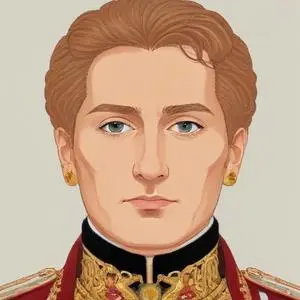
Emperor of Russia from 1801 to 1825, known for his liberal reforms and role in defeating Napoleon, leading to a significant shift in European politics.
Alexander I, known as the "Blessed," was the Emperor of Russia who ruled during the tumultuous period of the Napoleonic Wars, leaving an indelible mark on Russian history. He was a shrewd leader who masterfully navigated the complex web of alliances and rivalries, earning him a reputation as a skilled diplomat and strategist.
Born on December 23, 1777, Alexander was the eldest son of Emperor Paul I and Sophie Dorothea of Württemberg. Following his father's assassination in 1801, Alexander ascended to the throne, marking the beginning of a transformative era in Russian history.
In the early years of his reign, Alexander espoused liberal rhetoric, echoing the Enlightenment ideals of his time. He appointed Mikhail Speransky, a forward-thinking reformer, as one of his closest advisors, and together they implemented a series of reforms aimed at modernizing Russia's educational system, judiciary, and administrative structures.
Alexander's foreign policy was marked by a complex dance of alliances and rivalries with European powers, particularly Napoleon's France. He shifted Russia's position four times between 1804 and 1812, navigating the treacherous landscape of European politics with aplomb.
Alexander's reign had a profound impact on Russian society, culture, and politics. He laid the foundations for Russia's emergence as a major European power, while also shaping the country's cultural identity and national consciousness.
His legacy is complex and multifaceted, reflecting the contradictions and paradoxes of his rule. He was a champion of liberal reforms, yet maintained an autocratic grip on power. He was a skilled diplomat, yet struggled to reconcile Russia's relations with Europe.
Despite these contradictions, Alexander I remains an enigmatic figure, a testament to the intrigue and drama of Russian history. His reign continues to fascinate historians and scholars, offering a rich tapestry of insights into the complexities of statecraft, diplomacy, and leadership.
Born in 1769
A French military leader who rose to prominence during the French Revolution and became Emperor of France, known for his military conquests and reorganization of Europe. He is also famous for his Napoleonic Code, which remains a foundation of modern law.
Born in 1729
Empress of Russia from 1762 to 1796, she transformed her country into a major European power, modernizing its culture, politics, and economy through numerous reforms and conquests.
Born in 1672
Reformed Russia's government, military, and culture, transforming it into a major European power. Known for modernizing and westernizing the country through numerous reforms and founding St. Petersburg.
Born in 1868
The last emperor of Russia, ruling from 1894 to 1917, known for his poor leadership and decisions that led to the downfall of the Romanov dynasty and the rise of communism.
Born in 1845
The Russian monarch who ruled from 1881 to 1894, known for his conservative and nationalistic policies, as well as his efforts to reform the Russian Empire's government and economy.
Born in 1845
The Russian monarch who ruled from 1881 to 1894, known for his conservative and nationalistic policies, as well as his efforts to reform the Russian Empire's government and economy.
Born in 1868
The last emperor of Russia, ruling from 1894 to 1917, known for his poor leadership and decisions that led to the downfall of the Romanov dynasty and the rise of communism.
74 Years Old
A Russian politician who has dominated the country's politics for over two decades, known for his authoritarian leadership style and controversial foreign policy decisions.
