


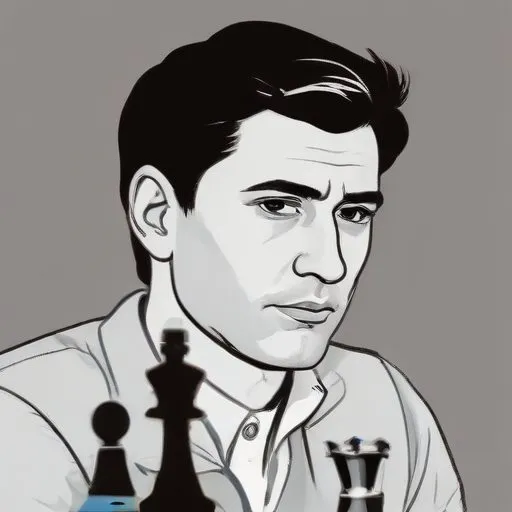
A Russian chess grandmaster and author, known for winning the FIDE World Chess Championship in 1999 and writing books on chess strategy.
Alexander Khalifman, the Russian chess grandmaster, is renowned for his unprecedented victory in the 1999 FIDE World Chess Championship, a title he held until the following year. This remarkable feat catapulted him to international recognition, earning him a place among the chess elite.
Born on January 18, 1966, in St. Petersburg, Russia, Khalifman hails from a Jewish family of engineers. His grandfather, a director of the Chaliapin Museum, played a significant role in shaping his early life. Interestingly, family legends suggest that one of Khalifman's ancestors was a commander of the Russian monitor Rusalka, adding a touch of maritime flair to his family's storied past.
Khalifman's exceptional talent was evident from an early age. He won the 1982 Soviet Union Youth Championship, followed by the 1984 and 1985 titles. His impressive performance continued with wins at the 1985 European Under-20 Championship in Groningen, the 1990 Groningen tournament, and the 1993 Ter Apel tournament, among many others.
His remarkable victories earned him the Grandmaster title in 1990, with notable achievements including his first-place finish at the 1990 New York City Open ahead of a host of strong players. He also played a crucial role in the Russian team's gold medal wins at the Chess Olympiads in 1992, 2000, and 2002, as well as the 1997 World Team Chess Championship.
Khalifman's most notable achievement was winning the FIDE World Chess Championship in 1999, a title he held until the following year. Interestingly, he was rated 44th in the world at the time, while Classical World Champion Garry Kasparov was rated No. 1. Khalifman's comments after the tournament sparked controversy, as he stated, "Rating systems work perfectly for players who play only in round-robin closed events. I think most of them are overrated. Organizers invite same people over and over because they have the same rating, and their rating stays high."
Khalifman's win was not without controversy, and his comments sparked debate about the rating system and tournament formats. His views highlight the need for a more nuanced approach to chess rankings and the importance of considering a player's overall performance.
Khalifman's personal life is marked by his dedication to chess and his family. His wife, Tatiana, has been a constant source of support throughout his career. Together, they have two children, and Khalifman has often spoken about the importance of balancing his chess career with family life.
Alexander Khalifman's remarkable achievements have inspired a generation of chess players. His unassuming nature and commitment to the game have earned him a special place in the hearts of chess enthusiasts worldwide. His legacy continues to grow, as he remains an active participant in the chess community, sharing his wisdom and expertise with aspiring players.
In conclusion, Alexander Khalifman's remarkable journey is a testament to his dedication, perseverance, and passion for chess. His contributions to the game have left an indelible mark, and his inspirational story continues to captivate audiences around the world.
63 Years Old
A Russian chess grandmaster and writer, renowned for being the world's top-ranked player for most of the 1980s and 1990s, and for his advocacy of democracy and human rights.
56 Years Old
A world chess champion, holding the title five times, and known for his creative and attacking playing style. He's a global icon in the chess world, inspiring millions of players.
51 Years Old
A Russian chess grandmaster who dominated the game for over a decade, becoming the undisputed World Chess Champion in 2006. He's renowned for his strategic and positional playing style.
89 Years Old
A Soviet chess grandmaster who dominated the game in the 1960s and 1970s, famously competing against Bobby Fischer in the 1972 World Chess Championship. He is known for his strategic and positional playing style.
Born in 1911
A Soviet chess grandmaster and engineer who dominated the game from the 1940s to 1960s, winning six World Chess Championships and developing the first chess-playing computer program.
97 Years Old
Armenian chess grandmaster who reigned as World Chess Champion from 1963 to 1969, known for his defensive playing style and ability to draw games from seemingly impossible positions.
44 Years Old
An Armenian chess grandmaster who has been one of the world's top-ranked players, known for his creative and attacking playing style. He has won numerous tournaments and awards, including four World Chess Cup titles.
