


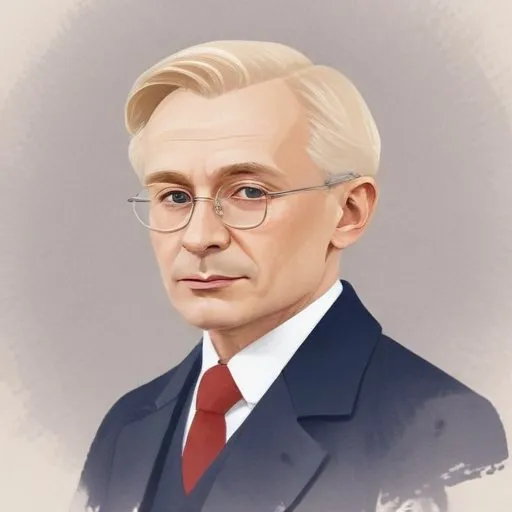
Developed the first Soviet computer, MESM, and made significant contributions to computer science, including the creation of the first Russian compiler.
Alexander Kronrod, a renowned mathematician and computer scientist, is best known for his pioneering work in the development of the first Soviet computer, the MESM, and his significant contributions to the field of algorithm theory.
Born in 1921 in Moscow, Russia, Kronrod's fascination with mathematics began at a young age. He pursued his passion, earning a degree in mathematics from Moscow State University in 1943. His academic pursuits continued, as he went on to receive his Ph.D. in mathematical sciences from the Steklov Mathematical Institute in 1947.
Kronrod's most notable achievement is the development of the MESM ( Малая Электронно-Счётная Машина, or Small Electronic Calculating Machine), the first fully functional Soviet computer. Completed in 1951, the MESM marked a significant milestone in the history of computer science, demonstrating the feasibility of electronic computers.
Throughout his career, Kronrod made substantial contributions to the field of algorithm theory, authoring numerous papers on topics such as computational complexity, programming languages, and data structures. His work on the development of the first Soviet programming language, ARSENAL, further solidified his reputation as a leading computer scientist of his time.
Kronrod's mathematical philosophy was deeply rooted in his conviction that mathematical concepts should be grounded in empirical reality. He believed that mathematical abstractions should be derived from concrete problems, rather than being purely theoretical constructs.
This pragmatic approach is reflected in his work on algorithm theory, where he sought to develop practical solutions to computational problems, rather than merely exploring theoretical possibilities.
Kronrod's contributions to computer science have had a lasting impact on modern society. The development of the MESM paved the way for the creation of more advanced computers, which have revolutionized numerous aspects of modern life, from communication and commerce to medicine and education.
Moreover, Kronrod's work on algorithm theory has influenced the development of artificial intelligence, machine learning, and data analysis, which are crucial components of contemporary technology.
In 1953, Kronrod was awarded the Stalin Prize for his work on the MESM. This prestigious award recognized his significant contributions to the field of computer science.
In addition to his academic achievements, Kronrod was an avid chess player and participated in several international chess tournaments, demonstrating his remarkable cognitive abilities beyond the realm of mathematics and computer science.
Kronrod's work took place during a period of significant technological and scientific advancement in the Soviet Union. The development of the MESM, in particular, was a testament to the Soviet Union's commitment to scientific progress and innovation.
Today, Kronrod's legacy continues to inspire new generations of mathematicians, computer scientists, and engineers. His pioneering work in computer science has left an indelible mark on the history of technology, and his contributions remain a vital part of the ongoing development of modern computing.
Kronrod's remarkable life and achievements serve as a testament to the power of human ingenuity and dedication to scientific progress. His legacy continues to shape the world of computer science, and his contributions remain an essential part of the rich tapestry of scientific history.
Born in 1903
Developed theories on probability, topology, and complexity, making significant contributions to modern mathematics and computer science.
Born in 1908
Developed the theory of distributions, a fundamental concept in mathematics, and made significant contributions to the fields of calculus, functional analysis, and partial differential equations.
Born in 1856
Developed the theory of Markov chains, a mathematical system that undergoes transitions from one state to another, and is widely used in computer science, biology, and economics.
Born in 1909
Developed mathematical methods for quantum field theory and made significant contributions to the development of theoretical physics, particularly in the areas of statistical mechanics and quantum mechanics.
Born in 1908
A renowned physicist and academic who made groundbreaking contributions to our understanding of quantum mechanics, superfluidity, and particle physics, earning a Nobel Prize in Physics in 1962.
Born in 1921
A Soviet physicist and dissident who advocated for human rights and nuclear disarmament, earning a Nobel Peace Prize in 1975. He's known for his courageous stance against the Soviet regime, promoting peace and democracy.
88 Years Old
A renowned mathematician and academic, he was awarded the Fields Medal for his groundbreaking contributions to topology and algebraic geometry. His work has far-reaching implications for our understanding of geometric structures.
