


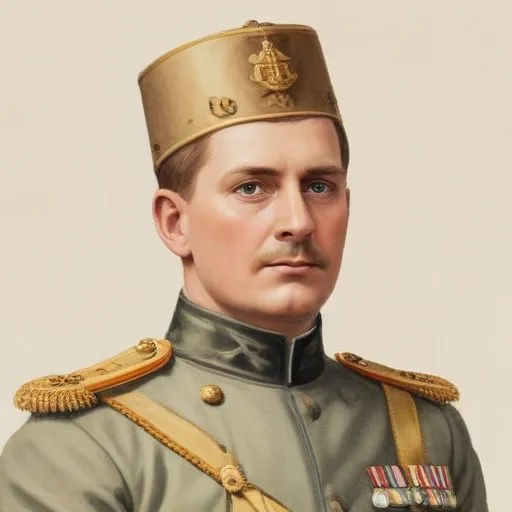
First ruler of modern Bulgaria, liberating the country from Ottoman rule and establishing a modern state. He's known for his efforts to modernize and westernize Bulgaria.
Alexander of Battenberg, also known as Alexander I of Bulgaria, was the first prince of the autonomous Principality of Bulgaria from 1878 to 1886. He is renowned for his role in shaping Bulgaria's modern identity, unifying the country, and leading it towards independence from the Ottoman Empire.
Born on April 5, 1857, Alexander was the second son of Prince Alexander of Hesse and by Rhine and Countess Julia von Hauke. His family ties were impressive, being the nephew of Russia's Tsar Alexander II and having a mother who was a lady-in-waiting to the Tsaritsa.
In 1878, the Bulgarian Grand National Assembly elected Alexander as the Prince of autonomous Bulgaria. This marked the beginning of a new era for the country, as Alexander worked tirelessly to modernize and unite the nation.
In 1880, Alexander dissolved the National Assembly and suspended the Constitution in 1881, citing its liberal nature. However, he restored the Constitution in 1883, which led to open conflict with Russia. This move made him incredibly popular among the Bulgarian people.
Alexander's greatest achievement was the unification of Bulgaria with Eastern Rumelia in 1885, which was recognized by the great powers. This monumental feat cemented his place in Bulgarian history and earned him the respect of European leaders.
A pro-Russian coup in 1886 forced Alexander to abdicate, and he went on to serve as a general in the Austrian army. Despite his tumultuous exit from Bulgaria, Alexander's legacy endured, and he remained a beloved figure in Bulgarian politics.
Alexander was known to his family and friends as "Sandro" or "Drino." His brother, Prince Louis of Battenberg, married Princess Victoria of Hesse and by Rhine, making Alexander an uncle to Queen Louise of Sweden and Earl Mountbatten of Burma. Another brother, Prince Henry of Battenberg, married Queen Victoria's youngest daughter, Princess Beatrice.
Alexander of Battenberg's contributions to Bulgaria's independence and modernization cannot be overstated. He played a pivotal role in shaping the country's identity and paving the way for its future growth. Today, he is remembered as a visionary leader who fought tirelessly for his nation's freedom and prosperity.
Born in 1819
The monarch who ruled the British Empire for 63 years, overseeing the Industrial Revolution and expanding the empire's reach, earning the nickname "the Grandmother of Europe".
