


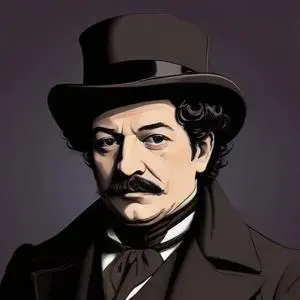
French novelist and playwright behind iconic works like "The Lady of the Camellias", known for his romantic and dramatic stories that often explored themes of love, morality, and social class.
Alexandre Dumas, fils, the son of the legendary author Alexandre Dumas, père, is renowned for his exceptional contributions to French literature, particularly in the realm of drama. He is best known for his iconic play, The Lady of the Camellias, which has become an archetype for the tragic heroine in modern literature.
Born on July 27, 1824, in Paris, France, Alexandre Dumas, fils was destined for greatness. His father, Alexandre Dumas, père, was a celebrated author, and their household was often filled with literary figures and intellectuals. This environment instilled in Dumas, fils a deep love for literature and the arts from an early age.
Dumas, fils began his literary career as a journalist and playwright. His early works, such as The Demi-Monde, showcased his talent for crafting intricate plots and complex characters. However, it was The Lady of the Camellias, first performed in 1852, that catapulted him to fame. The play's success was unprecedented, with its tumultuous love story and flawed heroine captivating audiences worldwide.
Dumas, fils' works often explored the human condition, delving into themes of love, morality, and social class. He believed that art should reflect reality and challenge societal norms. His plays frequently featured strong, independent female characters, which was a departure from the traditional portrayals of women in literature at the time.
The Lady of the Camellias has had a profound impact on modern literature and popular culture. The play has inspired numerous adaptations, including Verdi's opera La Traviata and Greta Garbo's iconic film portrayal of Marguerite Gautier. Dumas, fils' work has also influenced writers such as Émile Zola and Guy de Maupassant, cementing his place in the French literary canon.
In 1864, Dumas, fils was elected to the French Academy, a testament to his literary prowess. He married Nadine de Servigny in 1867 and had one son, Jeanine Dumas. Throughout his life, he remained devoted to his craft, continuing to write until his passing on November 27, 1895.
Alexandre Dumas, fils was a prominent figure in the French literary scene during the 19th century. His work reflects the social and cultural upheavals of the time, as well as his own experiences and observations. Today, he is remembered as a master of French drama, whose works continue to captivate audiences and inspire new generations of writers and artists.
In comparison to his contemporaries, such as Gustave Flaubert and Honoré de Balzac, Dumas, fils' work is distinct in its focus on the dramatic and the emotional. While his peers focused on the novel as a medium, Dumas, fils excelled in the realm of theater, crafting plays that were both intellectually stimulating and emotionally resonant.
Throughout his life, Dumas, fils was driven by a passion for storytelling and a desire to explore the complexities of the human experience. His work serves as a testament to the power of creativity and perseverance, inspiring future generations to push the boundaries of art and literature.
Born in 1802
Wrote iconic adventure novels like "The Count of Monte Cristo" and "The Three Musketeers", creating unforgettable characters and stories that have stood the test of time.
Born in 1821
A pioneering realist novelist who crafted meticulous, psychologically nuanced portrayals of 19th-century French life, particularly in his iconic novel "Madame Bovary".
Born in 1799
A prolific writer who created a vast array of characters and stories that explored the human condition, particularly in the context of post-Napoleonic France. His works are considered a cornerstone of French literature.
Born in 1811
A French Romantic poet and critic who championed the beauty of art for art's sake, and is known for his vivid descriptions of nature and the human experience.
Born in 1808
A French Romantic poet and translator, known for his vivid and dreamlike writings that explored the realms of fantasy and the human psyche. His works often blurred the lines between reality and imagination.
Born in 1840
A 19th-century literary mastermind, celebrated for his vivid depictions of French life and poignant short stories, particularly "The Last Lesson" and "Tartarin of Tarascon".
Born in 1850
A 19th-century French literary mastermind who crafted hauntingly beautiful short stories and novels that probed the human psyche, often with a dark, ironic twist. His works remain widely read and adapted today.
