


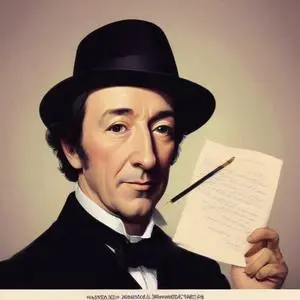
A 19th-century French historian and philosopher who traveled to America to study its democracy, producing a seminal work on the country's political and social structures. He's known for his insightful commentary on the American experiment and its implications for modern democracy.
Alexis de Tocqueville is renowned for his groundbreaking works, Democracy in America and The Old Regime and the Revolution, which have had a profound impact on the fields of sociology, political science, and history. These seminal books have cemented his reputation as a pioneering thinker, offering unparalleled insights into the intricacies of democracy, social conditions, and the human experience.
Born on July 29, 1805, in Paris, France, Alexis de Tocqueville hailed from an aristocratic Norman family. His great-grandfather, Malesherbes, was a distinguished statesman who met a tragic fate during the French Revolution. This legacy of public service and intellectual curiosity would shape Tocqueville's future endeavors.
In 1831, Tocqueville embarked on a journey to the United States, which would become the catalyst for his magnum opus, Democracy in America. During his nine-month sojourn, he traveled extensively, observing the American way of life, conversing with ordinary citizens, and taking meticulous notes. This firsthand experience allowed him to craft a nuanced, comprehensive analysis of American democracy, exploring its strengths, weaknesses, and implications for the modern world.
Tocqueville's Democracy in America (1835-1840) is hailed as a foundational work of sociology and political science, offering a prescient examination of American society, politics, and institutions.
In The Old Regime and the Revolution (1856), Tocqueville presented a searing critique of the French Revolution, attributing its failures to the inexperience of its leaders and their adherence to abstract Enlightenment ideals.
As a classical liberal, Tocqueville advocated for parliamentary government, tempering his faith in democracy with a healthy skepticism towards the dangers of majoritarianism.
Tocqueville's involvement in French politics spanned multiple regimes, including the July Monarchy (1830-1848) and the Second Republic (1848-1851). During this period, he navigated the complexities of French politics, serving as a member of parliament and holding various ministerial positions. His experiences during this tumultuous era would later inform his literary output.
Alexis de Tocqueville's intellectual legacy extends far beyond his native France, influencing thinkers across the political spectrum. His work continues to resonate with contemporary debates on democracy, social justice, and individual freedom. As a testament to his enduring relevance, Tocqueville's ideas have inspired scholars, policymakers, and citizens alike, fostering a deeper understanding of the human condition and the complexities of modern democracy.
1835: Publication of the first volume of Democracy in America, which garnered widespread critical acclaim.
1840: Publication of the second volume of Democracy in America.
1851: Resignation from political life following Louis Napoleon Bonaparte's coup.
1856: Completion of The Old Regime and the Revolution.
April 16, 1859: Tocqueville's passing, leaving behind a rich intellectual heritage.
"The American Republic will endure until the day Congress discovers that it can bribe the public with the public's money."
"There are many men of principle in both parties in America, but there is no party of principle."
Alexis de Tocqueville's life and work serve as a testament to the enduring power of ideas, illuminating the complexities of human society, and inspiring future generations of thinkers and policymakers. His unwavering commitment to democracy, social justice, and individual liberty has left an indelible mark on modern thought, ensuring his continued relevance in an ever-changing world.
Born in 1712
A pioneering thinker who shaped modern democracy and education with his ideas on social contracts, general will, and the importance of early childhood education. His writings influenced the French Revolution and modern political thought.
Born in 1632
A 17th-century thinker who laid the groundwork for modern democracy, arguing that governments derive their power from the people and that individuals have inherent rights to life, liberty, and property.
Born in 1694
A witty and insightful 18th-century writer and philosopher who used satire to critique societal norms and advocate for reason, tolerance, and human rights.
Born in 1724
Developed influential philosophical frameworks, such as the Critique of Pure Reason, that shaped modern Western thought on ethics, morality, and human understanding.
Born in 1689
A French lawyer and philosopher who developed the concept of separation of powers, which divides a government into legislative, executive, and judicial branches to prevent abuse of power. His ideas greatly influenced modern democracy.
Born in 1588
A 17th-century philosopher who introduced the concept of social contract, arguing that people voluntarily give up some rights to a sovereign power in exchange for protection and stability. His ideas shaped modern political thought and the nature of government.
Born in 1806
A prominent 19th-century thinker who championed individual liberty, free speech, and women's rights, and is best known for his influential book "On Liberty".
Born in 1729
An 18th-century thinker who shaped modern conservatism, advocating for gradual social change and warning against the dangers of radical revolution. He's also known for his philosophical writings on aesthetics and the sublime.
