


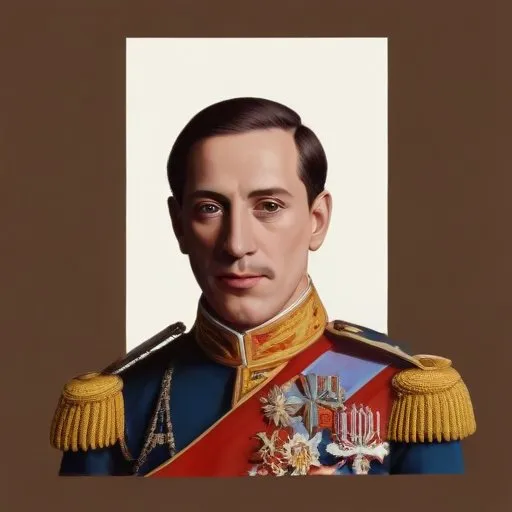
The last Bourbon king of Spain, ruling from 1886 to 1931, known for his tumultuous reign marked by political instability, economic struggles, and the loss of Spain's last colonies.
Known as the "Africanist" for his military campaigns in North Africa, Alfonso XIII of Spain was a monarch who ruled with a mix of authoritarianism and modernization. His reign, which spanned from 1886 to 1931, was marked by contradictions – he was a strong supporter of the arts and culture, yet his country faced economic stagnation and political unrest.
Born on May 17, 1886, in Madrid, Spain, Alfonso XIII was the posthumous son of King Alfonso XII and Queen Maria Christina of Austria. His early life was marked by tragedy, with the death of his father before his birth and his mother's subsequent regency until he came of age.
Alfonso XIII's military campaigns in North Africa, particularly in Morocco, earned him the nickname "The Africanist." He saw these conquests as a way to restore Spain's lost glory and expand its colonial empire.
The Riff War, fought from 1920 to 1926, was a brutal conflict that saw Spanish forces clash with the Berber tribes of Morocco. Alfonso XIII's government was criticized for its heavy-handed approach, which led to widespread human rights abuses and international condemnation.
Alfonso XIII's personal life was marked by scandal and romantic intrigue. His marriage to Princess Victoria Eugenie of Battenberg was tumultuous, with rumors of infidelity and mistresses.
As the Spanish people grew disillusioned with the monarchy and the country's economic and political woes, Alfonso XIII's popularity plummeted. In 1931, he was forced to abdicate the throne, marking the end of the Bourbon dynasty in Spain.
The former king spent the remainder of his life in exile, first in France and later in Italy, where he died on February 28, 1941.
In the end, Alfonso XIII's legacy is one of contradictions – a king who sought to modernize and expand his country's influence, yet was ultimately undone by his own authoritarianism and personal scandals.
Despite his flaws, Alfonso XIII remains a complex and fascinating figure in Spanish history – a king who embodied both the grandeur and the tragedy of Spain's tumultuous 20th century.
Born in 1887
The last queen of Spain before the abolition of the monarchy, she was a British princess who married King Alfonso XIII and played a significant role in Spanish history.
Born in 1886
The last Bourbon king of Spain, ruling from 1886 to 1931, known for his tumultuous reign marked by political instability, economic struggles, and the loss of Spain's last colonies.
Born in 1858
The Queen of Spain who ruled alongside her husband King Alfonso XII and later as regent for her son Alfonso XIII, known for her strong leadership and modernizing reforms.
Born in 1892
The authoritarian leader who ruled Spain with an iron fist from 1939 to 1975, suppressing opposition and imposing conservative values, while also modernizing the economy. He's infamous for his brutal regime and human rights abuses.
88 Years Old
The former King of Spain who reigned from 1975 to 2014, known for transitioning the country from dictatorship to democracy and playing a key role in preventing a military coup in 1981.
58 Years Old
The current King of Spain, reigning since 2014, known for his efforts to modernize the monarchy and promote Spanish culture. He's also been involved in various charitable initiatives and international diplomacy.
88 Years Old
The former King of Spain who reigned from 1975 to 2014, known for transitioning the country from dictatorship to democracy and playing a key role in preventing a military coup in 1981.
