


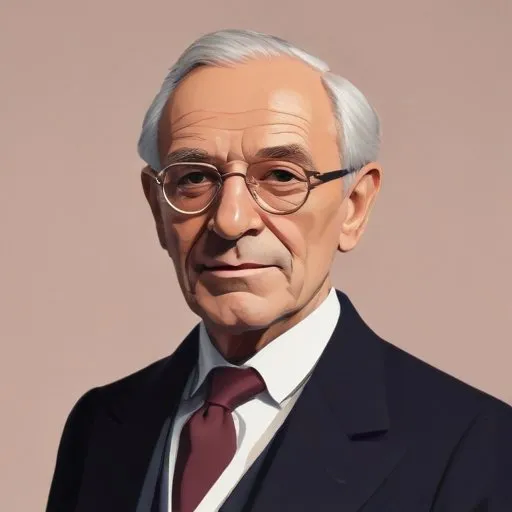
A pioneering pacifist and journalist who advocated for international cooperation and disarmament, earning the Nobel Peace Prize in 1911. He's most known for his tireless efforts to promote peace and prevent war.
Alfred Hermann Fried, an Austrian Jewish pacifist, publicist, and journalist, is best known for being the co-founder of the German peace movement and the winner of the Nobel Peace Prize in 1911, alongside Tobias Asser. His tireless efforts to promote international peace and understanding have left an indelible mark on modern society.
Born on November 11, 1864, in Vienna, Austria, Fried was raised in a Hungarian-Jewish family. His father was from Szigetvár, and his mother, Bertha Engel, was from Budapest. Fried's educational journey was cut short when he left school at the age of 15 to work in a bookshop. In 1883, he moved to Berlin, where he opened his own bookshop in 1887.
In 1889, Fried was inspired by Bertha von Suttner's publication of "Die Waffen nieder" (Lay Down Your Arms), which sparked his interest in pacifism. He and von Suttner began printing a magazine of the same name in 1892, where Fried articulated his pacifist philosophy. This marked the beginning of his lifelong commitment to promoting peace and non-violence.
In 1892, Fried co-founded the German Peace Society (Deutsche Friedensgesellschaft), a pioneering organization that strove to promote international peace and understanding. He was also an ardent supporter of Esperanto, an artificial language intended to facilitate international communication. Fried authored an Esperanto textbook and an Esperanto-German and German-Esperanto dictionary, first published in 1903 and republished in 1905.
In 1911, Fried was awarded the Nobel Peace Prize, along with Tobias Asser, for his outstanding contributions to the pacifist movement. During World War I, Fried moved to neutral Switzerland, where he continued to advocate for international peace. He passed away on May 4, 1921, leaving behind a legacy that continues to inspire generations.
Fried's pacifist philosophy emphasized the importance of international cooperation and understanding. He believed that wars could be avoided through diplomacy, education, and the promotion of a common language, such as Esperanto. His work laid the foundation for modern international organizations, including the League of Nations and the United Nations.
Alfred Hermann Fried's legacy extends beyond the pacifist movement. He played a significant role in shaping modern international relations, inspiring generations of pacifists, and promoting the use of Esperanto as a means of international communication. His work continues to influence contemporary discussions on international peace, conflict resolution, and global cooperation.
Born in 1843
A pioneering pacifist and writer, she championed international disarmament and peace, earning the first Nobel Peace Prize awarded to a woman. Her groundbreaking work inspired a generation of peace activists.
Born in 1822
A French economist and academic who was awarded the Nobel Peace Prize in 1901 for his efforts to establish the International Committee of the Red Cross and promote international arbitration. He is known for his pioneering work in promoting peace and conflict resolution.
Born in 1828
Co-founder of the Red Cross, a humanitarian organization providing aid in war zones and natural disasters, and a Nobel Peace Prize winner for his efforts. He pioneered the concept of international humanitarian law.
Born in 1845
A prominent lawyer and politician who served as Secretary of State, earning a Nobel Peace Prize for his diplomatic efforts. He's most known for his work in international arbitration and conflict resolution.
Born in 1862
A renowned philosopher and educator, he was a leading figure in the development of American education and international relations, and was awarded the Nobel Peace Prize in 1931.
Born in 1860
A pioneering social worker and peace activist, she founded Hull House, a settlement that provided social services to immigrants and the working poor, and was awarded the Nobel Peace Prize in 1931.
Born in 1872
A pioneering thinker who argued that war is economically futile and that nations are interdependent, known for his influential book "The Great Illusion".
Born in 1866
A Scottish journalist and politician who served as the first Labour Party Prime Minister of the United Kingdom, leading the country through significant economic and social reforms. He is also known for his efforts to maintain peace in Europe during the interwar period.
