


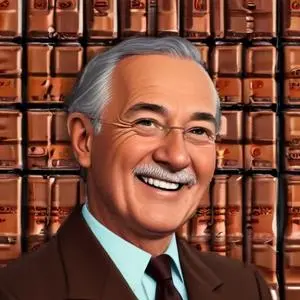
Discovered the role of DNA in bacterial reproduction, and proved that genetic information is encoded in DNA, revolutionizing our understanding of genetics.
Alfred Hershey, the renowned American bacteriologist and geneticist, left an indelible mark on the scientific community by confirming that DNA, not protein, is the genetic material of life. His groundbreaking discovery, made possible through the famous Hershey-Chase experiment, earned him the Nobel Prize in Physiology or Medicine in 1969.
Born on December 4, 1908, in Owosso, Michigan, Hershey grew up with an innate curiosity about the natural world. He earned his Bachelor of Science degree in chemistry from Michigan State University in 1930, followed by a Ph.D. in bacteriology in 1934.
Hershey's fascination with bacteriophages, viruses that infect and replicate inside bacteria, led him to join the faculty of Washington University in St. Louis as an instructor of bacteriology and immunology in 1934. His work on phages brought him together with fellow researchers Max Delbrück and Salvador Luria, forming the core of an informal network known as the Phage Group.
In 1943, Delbrück invited Hershey to Vanderbilt University to discuss his phage research. This collaboration would eventually lead to their independent discovery of genetic recombination, where different strains of bacteriophage exchange genetic material when infecting the same bacterial cell.
In 1952, Hershey and his colleague Martha Chase conducted the iconic Waring Blender experiment, which conclusively demonstrated that DNA is the genetic material of life. This pioneering work involved blending bacteriophages with bacterial cells and then separating the virus particles from the DNA. The results showed that the genetic material responsible for infecting the bacteria was DNA, not protein.
In 1962, Hershey became the director of the Department of Genetics at the Carnegie Institution of Washington, a position he held until his retirement in 1970. He continued to work at Cold Spring Harbor Laboratory, where he lived on the grounds until his passing on May 22, 1997.
Hershey's work embodied the spirit of scientific inquiry, demonstrating the power of curiosity-driven research and collaboration. His discovery of DNA as the genetic material of life has had a profound impact on our understanding of biology and medicine, influencing generations of scientists and researchers.
Hershey's journey was marked by a strong sense of purpose and dedication to his work. His collaboration with the Phage Group, his move to Cold Spring Harbor Laboratory, and his Nobel Prize win were all significant milestones in his remarkable career.
Alfred Hershey's legacy continues to inspire scientists and researchers, reminding us of the importance of fundamental research and the power of human curiosity in advancing our understanding of the world.
Born in 1925
A pioneering geneticist who discovered bacterial gene recombination and transduction, revolutionizing our understanding of genetic inheritance and earning a Nobel Prize.
Born in 1916
Pioneering scientist who discovered the structure of DNA, revolutionizing our understanding of genetics and life itself.
98 Years Old
Discovered the structure of DNA, revolutionizing our understanding of genetics and earning a Nobel Prize. Pioneering work in molecular biology has far-reaching implications for medicine and beyond.
Born in 1920
A British scientist who contributed significantly to the discovery of the structure of DNA, providing high-quality X-ray crystallography images that helped James Watson and Francis Crick develop their famous model.
Born in 1916
A Nobel Prize-winning physicist and biologist who contributed significantly to the discovery of the structure of DNA, using X-ray crystallography to produce the first clear images of the molecule.
Born in 1901
Pioneering chemist and peace activist who won two unshared Nobel Prizes, one for chemistry and one for peace, for his groundbreaking work on the nature of the chemical bond and his tireless efforts to promote nuclear disarmament.
Born in 1905
A pioneer in DNA research, this biochemist discovered the base pairing rules of DNA, leading to a fundamental understanding of genetic code.
Born in 1918
Developed techniques for sequencing DNA and proteins, revolutionizing molecular biology and earning two Nobel Prizes in Chemistry.
