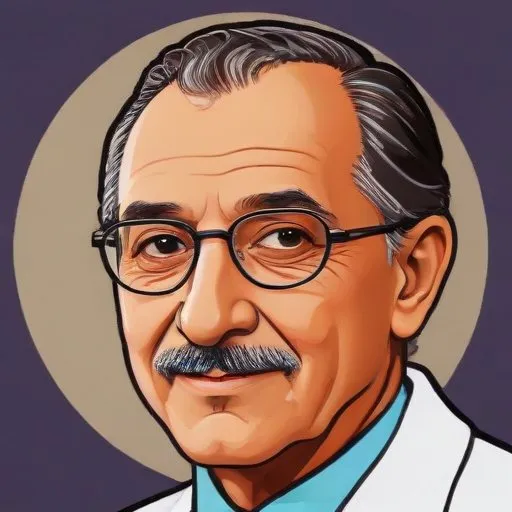
Salvador Luria: The Microbiologist Who Unlocked the Secrets of Viruses
The Nobel Prize Winner Who Revolutionized Our Understanding of Viral Replication
Salvador Luria is renowned for his groundbreaking discoveries on the replication mechanism and genetic structure of viruses, earning him the Nobel Prize in Physiology or Medicine in 1969, along with
Max Delbrück and
Alfred Hershey. His pioneering work on bacteriophages, viruses that infect bacteria, shed light on the intricate processes of viral replication and paved the way for significant advancements in microbiology.
Early Life and Education
Born Salvatore Luria on August 13, 1912, in Turin, Italy, to an influential Italian Sephardi Jewish family, Luria's intellectual curiosity was nurtured from an early age. He attended the medical school at the University of Turin, where he studied under the guidance of Giuseppe Levi and crossed paths with fellow future Nobel laureates
Rita Levi-Montalcini and
Renato Dulbecco. Luria graduated from the University of Turin in 1935, without pursuing a master's or PhD degree, as the Italian educational system at the time did not require or offer such degrees.
The Journey to the United States
Luria's academic pursuits were interrupted by his mandatory service in the Italian army as a medical officer from 1936 to 1937. Following his military service, he took classes in radiology at the University of Rome, where he was introduced to Max Delbrück's theories on the gene as a molecule. This sparked Luria's interest in testing genetic theory with bacteriophages. In 1938, he secured a fellowship to study in the United States, intending to work with Delbrück. However,
Benito Mussolini's fascist regime soon banned Jews from academic research fellowships, forcing Luria to flee to Paris, France.
Fleeing War and Finding New Opportunities
As Nazi Germany invaded France in 1940, Luria escaped on bicycle to Marseille, where he obtained an immigration visa to the United States. With the help of physicist
Enrico Fermi, Luria settled in New York City in September 1940, and soon adapted his first and middle names to Salvador Edward Luria. This marked the beginning of a new chapter in his life, as he embarked on a remarkable scientific journey in the United States.
Phage Research and the Nobel Prize
Luria's work on bacteriophages led to several critical discoveries, including the finding that bacterial resistance to phages is genetically inherited. This breakthrough, along with his contributions to the understanding of viral replication and genetic structure, earned him the Nobel Prize in Physiology or Medicine in 1969.
Legacy and Impact
Salvador Luria's pioneering work has left an indelible mark on the field of microbiology. His research has paved the way for significant advancements in our understanding of viral replication, genetic structure, and the development of new treatments for viral diseases. As a testament to his legacy, Luria's work continues to inspire new generations of scientists, ensuring that his groundbreaking discoveries will have a lasting impact on the scientific community.
Quotes and Memorable Sayings
- "The important thing is to understand that it's not a question of being right or wrong, but of being on the right or wrong path."
- "Science is not everything, but science is very close to everything."
Awards and Honors
- Nobel Prize in Physiology or Medicine (1969)
- National Medal of Science (1991)
Personal Milestones and Key Life Events
- Born on August 13, 1912, in Turin, Italy
- Fled to Paris, France, in 1938, and later to the United States in 1940
- Received the Nobel Prize in Physiology or Medicine in 1969
- Passed away on February 6, 1991
FAQ
What was Salvador Lurias most significant scientific discovery?
Salvador Lurias most significant scientific discovery was the demonstration of spontaneous mutation in bacteria, which challenged the prevailing view of Lamarckian inheritance and paved the way for modern molecular biology.
What was Salvador Lurias contribution to the field of microbiology?
Salvador Lurias contribution to the field of microbiology was the development of the phage group, which studied the genetics and behavior of bacteriophages. This work laid the foundation for our understanding of viral replication and gene expression.
What awards did Salvador Luria receive for his scientific contributions?
Salvador Luria received numerous awards, including the Nobel Prize in Physiology or Medicine in 1969, the National Medal of Science, and the Albert Lasker Award for Basic Medical Research.
What was Salvador Lurias role in the discovery of messenger RNA?
Salvador Luria played a key role in the discovery of messenger RNA (mRNA) through his work on the genetic code and the Central Dogma. His research helped establish the flow of genetic information from DNA to RNA to proteins.
How did Salvador Lurias work influence modern molecular biology?
Salvador Lurias work influenced modern molecular biology by laying the foundations for our understanding of gene expression, regulation, and evolution. His discoveries have had a lasting impact on fields such as genetics, virology, and biotechnology.