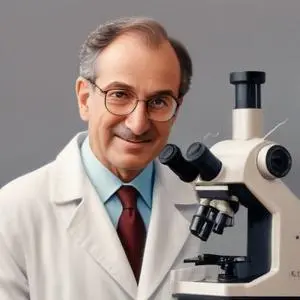
Renato Dulbecco: The Nobel Laureate Who Unravelled the Secrets of Oncoviruses
A Pioneer in Virology
Renato Dulbecco, a renowned Italian-American virologist, made history by winning the 1975 Nobel Prize in Physiology or Medicine for his groundbreaking work on oncoviruses, which are viruses that can cause cancer when they infect animal cells. His pioneering research has had a profound impact on our understanding of cancer and has paved the way for the development of new treatments and prevention strategies.
Early Life and Education
Born on February 22, 1914, in Catanzaro, Calabria, Southern Italy, Dulbecco grew up in Imperia, Liguria. He exhibited exceptional academic prowess from an early age, graduating from high school at just 16. He then moved to the University of Turin, where he developed a strong interest in mathematics and physics. However, he decided to pursue a career in medicine, graduating in morbid anatomy and pathology at the tender age of 22.
War and Resistance
Dulbecco's academic pursuits were interrupted by World War II. He was drafted into the Italian army in 1936 and later sent to the front in France and Russia, where he was wounded. After his hospitalization, he joined the resistance against the German occupation, demonstrating his courage and commitment to fighting against oppressive forces.
Career and Research
After the war, Dulbecco resumed his work at Giuseppe Levi's laboratory in Turin. He later moved to the United States, where he worked with
Salvador Luria on bacteriophages at Indiana University. In 1949, he joined
Max Delbrück's group at Caltech, where he began to explore the world of animal viruses. Dulbecco's research focused on developing a quantitative assay for animal viruses using a plaque technique, which revolutionized the field of virology.
The Nobel Prize and Legacy
Dulbecco's pioneering work on oncoviruses led to his Nobel Prize in 1975. His research has had a profound impact on our understanding of cancer and has paved the way for the development of new treatments and prevention strategies. His work has inspired generations of scientists, and his legacy continues to shape the field of virology.
Personal Milestones and Key Life Events
- Graduated from high school at 16
- Obtained his medical degree at 22
- Drafted into the Italian army in 1936
- Joined the resistance against the German occupation
- Moved to the United States in 1947
- Won the Nobel Prize in Physiology or Medicine in 1975
Influence on Modern Society
Dulbecco's work has had a significant impact on modern society, leading to a greater understanding of cancer and the development of new treatments and prevention strategies. His research has also inspired new generations of scientists, ensuring that his legacy continues to shape the field of virology.
Quotes and Memorable Sayings
- "The goal of science is to make the world a better place, not just to make a profit."
- "The only way to do great work is to love what you do."
Honors and Awards
- Nobel Prize in Physiology or Medicine (1975)
- National Medal of Science (2001)
- Albert Lasker Award (1964)
Conclusion
Renato Dulbecco's remarkable journey is a testament to his unwavering dedication to science and his unrelenting pursuit of knowledge. His groundbreaking work on oncoviruses has had a profound impact on our understanding of cancer, and his legacy continues to inspire new generations of scientists.
FAQ
What is Renato Dulbeccos most famous discovery?
Renato Dulbecco is perhaps best known for his discovery of the reverse transcriptase enzyme, which is essential for the replication of retroviruses. This discovery earned him the Nobel Prize in Physiology or Medicine in 1975.
What was Renato Dulbeccos role in the discovery of DNA?
Renato Dulbecco was part of the team that discovered the structure of DNA, working alongside James Watson and Francis Crick.
What is Renato Dulbeccos research focus?
Renato Dulbeccos research focuses on the molecular biology of cancer and viruses, particularly the role of oncogenes in cancer development.
What awards has Renato Dulbecco won?
In addition to the Nobel Prize, Renato Dulbecco has won several other awards for his work, including the National Medal of Science and the Albert Lasker Award.
What is Renato Dulbeccos legacy?
Renato Dulbeccos legacy is as a pioneer in the fields of molecular biology and virology. His discoveries have had a profound impact on our understanding of cancer and viruses, and have paved the way for significant advances in medicine.