


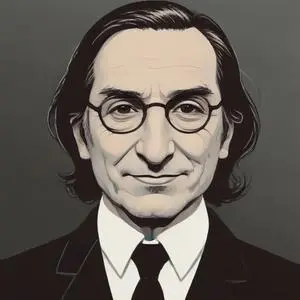
A German-Russian journalist and composer who blended different musical styles to create a unique sound, known for his polystylism and eclectic compositions.
Alfred Schnittke is arguably one of the most performed and recorded composers of late 20th-century classical music, renowned for his bold and eclectic style that defied conventions. His music is a testament to his relentless pursuit of artistic innovation, as he delved into the complexities of human experience, morality, and spirituality.
Schnittke was born on November 24, 1934, in Engels, Russia, to a Jewish father and a Volga German mother. His early life was marked by a cultural melting pot, with his father working as a journalist and translator, and his paternal grandmother being a philologist and editor of German-language literature. This rich cultural heritage had a profound impact on Schnittke's artistic vision, influencing his unique blend of styles and genres.
In the 1960s and 1970s, Schnittke developed his distinctive polystylistic technique, which drew from a wide range of genres, including jazz, pop, and avant-garde music. This innovative approach was exemplified in works such as his epic Symphony No. 1 (1969-1972) and Concerto Grosso I (1977). These compositions showcased his ability to seamlessly merge disparate styles, creating a rich tapestry of sound that was both provocative and mesmerizing.
The 1980s saw Schnittke's music gain widespread international recognition, with the publication of his String Quartets Nos. 2 and 3 (1980 and 1983) and String Trio (1985). This period also marked a significant shift in his artistic vision, as he began to explore more introspective and somber themes. His health began to deteriorate, and his music responded by abandoning some of the extroversion of his polystylism, retreating into a more withdrawn, bleak style.
Schnittke's oeuvre is marked by numerous masterpieces, including:
These works demonstrate Schnittke's unwavering commitment to artistic innovation, as he continued to push the boundaries of classical music.
Schnittke's music has had a profound impact on modern society, influencing a wide range of genres, from classical to rock and pop. His pioneering spirit and artistic vision have inspired generations of composers, musicians, and artists, cementing his legacy as one of the most important figures in late 20th-century classical music.
Schnittke's life was marked by several significant milestones, including:
These events had a profound impact on Schnittke's artistic vision, shaping his music and informing his unique perspective on the human experience.
Schnittke's words offer valuable insights into his artistic vision and philosophy:
These quotes demonstrate Schnittke's commitment to creating music that is both intellectually stimulating and emotionally resonant, reflecting his profound understanding of the human experience.
Schnittke's music occupies a unique position in the late 20th-century classical music landscape, bridging the gap between traditional and avant-garde styles. His legacy continues to inspire and influence contemporary composers, musicians, and artists, ensuring that his music remains an integral part of our cultural heritage.
Alfred Schnittke's remarkable life and career serve as a testament to the transformative power of music, inspiring generations to come. His bold and eclectic style has left an indelible mark on the world of classical music, cementing his position as one of the most important and innovative composers of the late 20th century.
99 Years Old
A renowned Russian cellist and conductor, celebrated for his virtuosic performances and advocacy for human rights and freedom of expression. He was a prominent figure in the classical music world, known for his collaborations with prominent composers and musicians.
79 Years Old
A renowned violinist and conductor, celebrated for his intense and expressive performances, as well as his advocacy for contemporary classical music.
73 Years Old
A renowned musician and conductor, celebrated for his virtuosic performances on both violin and viola, and his interpretations of classical and contemporary repertoire.
73 Years Old
A renowned Russian maestro, known for his intense and expressive performances, leading top orchestras and opera companies, and promoting Russian classical music globally.
55 Years Old
A renowned Russian pianist celebrated for his poetic and nuanced performances of classical music, particularly Chopin and Russian composers.
63 Years Old
A renowned violinist celebrated for her technical mastery and emotional depth, particularly in her interpretations of Mozart and Beethoven's works.
Born in 1925
A renowned Swedish operatic tenor celebrated for his versatility and impressive vocal range, performing leading roles in numerous operas and concerts worldwide.
Born in 1926
A renowned soprano and actress, celebrated for her powerful voice and iconic performances in Russian opera and film, earning her a Grammy Award and international acclaim.
