


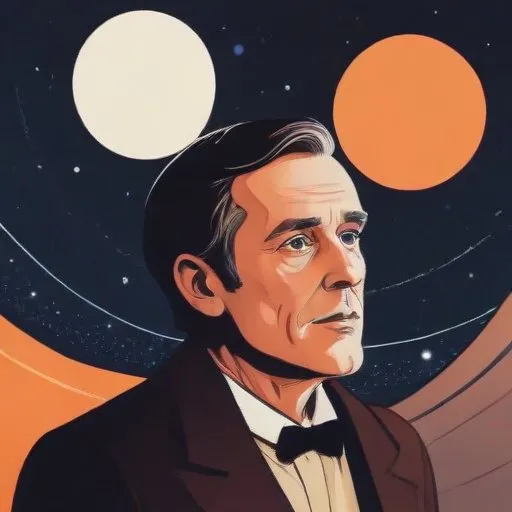
Pioneering astronomer and cosmologist who determined the first reasonably accurate values for the Hubble constant and the age of the universe. His work laid the foundation for modern cosmology.
Allan Rex Sandage was an American astronomer renowned for determining the first reasonably accurate values for the Hubble constant and the age of the universe. His groundbreaking work in cosmology and observational astronomy paved the way for a deeper understanding of the universe, earning him recognition as one of the most influential astronomers of the 20th century.
Sandage was born on June 18, 1926, in Iowa City, Iowa, United States. He graduated from the University of Illinois in 1948 and later received his PhD from the California Institute of Technology (Caltech) in 1953, under the guidance of German-born Wilson Observatory-based astronomer Walter Baade.
Sandage's work built upon the research of Edwin Hubble, with whom he worked as a graduate student assistant. After Hubble's passing in 1953, Sandage continued his research program, making significant contributions to the field of cosmology.
Sandage's contributions had a profound impact on our understanding of the universe, influencing modern astronomy and cosmology. His work on the Hubble constant and the age of the universe has been instrumental in shaping our comprehension of the universe's evolution.
Throughout his career, Sandage worked at the Palomar Observatory, where he published seminal papers on cosmology and observational astronomy. His work has inspired generations of astronomers, solidifying his position as a pioneer in the field.
Sandage received numerous awards and honors for his contributions to astronomy, including:
Sandage was born to a family of modest means and overcame early health issues to pursue his passion for astronomy. He was known for his humility and kindness, often preferring to work behind the scenes rather than seeking the spotlight.
Throughout his life, Sandage was driven by a deep curiosity about the universe and a passion for uncovering its secrets. His legacy continues to inspire astronomers and scientists around the world, ensuring that his work will have a lasting impact on our understanding of the cosmos.
Allan Sandage's life and work serve as a testament to the power of human curiosity and the importance of fundamental scientific research. As we continue to explore the universe, we are reminded of the profound impact that Sandage's work has had on our understanding of the cosmos.
Through his groundbreaking research and his legacy, Allan Sandage will forever be remembered as a giant in the field of astronomy, inspiring future generations to gaze up at the stars and wonder about the mysteries of the universe.
Born in 1889
Discovered galaxies beyond our own Milky Way, revolutionizing our understanding of the universe's scale and expansion. Pioneered observational cosmology, providing evidence for the Big Bang theory.
Born in 1893
German astronomer and author who discovered Andromeda Galaxy's distance from Earth, revolutionizing understanding of the universe's scale. Pioneered astronomical research using telescopes and photography.
Born in 1906
A renowned physicist and Nobel laureate who made groundbreaking contributions to our understanding of the universe, particularly in the fields of nuclear physics and astrophysics.
Born in 1910
A renowned scientist who pioneered our understanding of black holes and the behavior of stars, earning a Nobel Prize in Physics in 1983.
Born in 1926
Pioneering astronomer and cosmologist who determined the first reasonably accurate values for the Hubble constant and the age of the universe. His work laid the foundation for modern cosmology.
98 Years Old
Pioneering astronomer who confirmed the existence of dark matter, revolutionizing our understanding of the universe. Her groundbreaking research transformed the field of astrophysics.
Born in 1904
A Ukrainian-American physicist and cosmologist who developed the Big Bang theory and wrote popular science books, making complex concepts accessible to a broad audience.
