


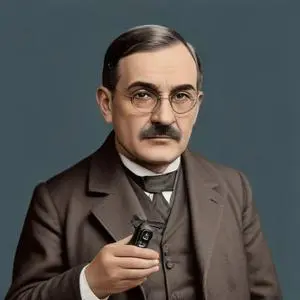
A German psychiatrist and neuropathologist who first identified and described the symptoms of a degenerative brain disorder now known as Alzheimer's disease, revolutionizing our understanding of dementia.
Alois Alzheimer, a German psychiatrist and neuropathologist, is renowned for identifying the first published case of presenile dementia, which would later bear his name – Alzheimer's disease. This groundbreaking discovery revolutionized the field of psychiatry and paved the way for a deeper understanding of the human brain.
Born on June 14, 1864, in Marktbreit, Bavaria, Alzheimer was the son of Anna Johanna Barbara Sabina and Eduard Romn Alzheimer. His devoutly Catholic family moved to Aschaffenburg when he was young, providing him with an opportunity to attend the prestigious Royal Humanistic Gymnasium. After graduating in 1883, Alzheimer pursued medicine at the University of Berlin, University of Tbingen, and University of Wrzburg.
In 1888, Alzheimer began his career at the City Mental Asylum in Frankfurt, where he worked under the guidance of Emil Sioli, a prominent psychiatrist. It was during this period that he met Franz Nissl, a neurologist with whom he collaborated on research projects. Together, they delved into the pathology of the nervous system, focusing on the normal and pathological anatomy of the cerebral cortex.
In 1906, Alzheimer encountered a patient named Auguste Deter, who displayed unusual symptoms such as memory loss, language difficulties, and unpredictable behavior. Upon her death, Alzheimer performed an autopsy and discovered abnormal clumps and tangles in her brain tissue, which he believed were the root cause of her condition. He presented his findings to the medical community, sparking a new era of research into the disease that would eventually bear his name.
Alzheimer's discovery has had a profound impact on modern society, leading to a greater understanding of the importance of brain health and the need for continued research into neurodegenerative diseases. His work has inspired countless researchers, clinicians, and caregivers, improving the lives of millions of people worldwide.
Alzheimer's approach to psychiatry was deeply rooted in his commitment to understanding the human brain as an integral part of the human experience. He believed that mental illnesses were not solely the result of psychological factors, but rather a complex interplay of biological, social, and environmental influences.
Alois Alzheimer's pioneering work has left an indelible mark on the fields of psychiatry, neurology, and medicine. His tireless efforts to understand the human brain have inspired generations of researchers and clinicians, and his discovery of Alzheimer's disease continues to shape our understanding of neurodegenerative diseases.
In the words of Alzheimer himself, "It is the fate of a scientific theory to be supplanted by a better one." Today, his legacy serves as a testament to the power of human curiosity and the importance of continued research into the mysteries of the human brain.
Born in 1856
A German psychiatrist and academic who developed the first modern classification system for mental illnesses, laying the foundation for modern psychiatry. He's also known for his work on dementia praecox, a precursor to schizophrenia.
Born in 1856
Pioneering psychoanalyst who developed theories on the subconscious mind, childhood experiences, and the structure of personality, revolutionizing our understanding of human behavior and psychology.
Born in 1875
Developed the concept of collective unconscious and archetypes, and founded analytical psychology, which emphasizes the integration of opposites and the process of individuation.
Born in 1857
A Swiss psychiatrist who coined the term "schizophrenia" and developed a more humane approach to treating mental illnesses, also advocating for forced sterilization of people with mental disabilities.
Born in 1864
A German psychiatrist and neuropathologist who first identified and described the symptoms of a degenerative brain disorder now known as Alzheimer's disease, revolutionizing our understanding of dementia.
Born in 1809
A German psychiatrist and author who created the beloved children's book "Struwwelpeter", featuring darkly humorous tales that warned of the consequences of misbehavior. His work remains a cultural icon in Germany and beyond.
