


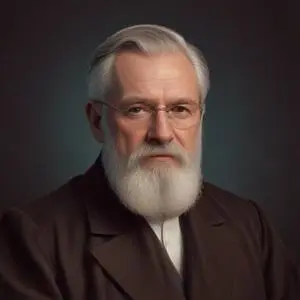
A German psychiatrist and academic who developed the first modern classification system for mental illnesses, laying the foundation for modern psychiatry. He's also known for his work on dementia praecox, a precursor to schizophrenia.
Emil Kraepelin, a German psychiatrist, is renowned for laying the foundations of modern scientific psychiatry, psychopharmacology, and psychiatric genetics. His groundbreaking work in the late 19th and early 20th centuries revolutionized the field, shaping the course of psychiatric research and treatment for generations to come.
Kraepelin was born on February 15, 1856, in Neustrelitz, Germany, to a family with a rich cultural heritage. His father, Karl Wilhelm, was a former opera singer, music teacher, and storyteller, while his brother Karl, 10 years his senior, would later become the director of the Zoological Museum of Hamburg. Kraepelin's early introduction to biology by his brother sparked a lifelong interest in the field.
Kraepelin began his medical studies at the University of Leipzig in 1874, where he was influenced by prominent figures such as Paul Flechsig, a renowned neuropathologist, and Wilhelm Wundt, a pioneer of experimental psychology. He completed his studies at the University of Würzburg in 1877-1878, further solidifying his foundation in neuropathology and experimental psychology.
Kraepelin's most significant contribution was his emphasis on the biological and genetic roots of psychiatric diseases. He believed that mental illnesses were primarily caused by biological and genetic malfunctions, rather than solely by environmental or psychological factors. This revolutionary concept dominated psychiatry in the early 20th century and experienced a resurgence in the latter half of the century.
Kraepelin's work also focused on the importance of empirical research, meticulous observation, and data collection. He developed a large-scale, clinically oriented, epidemiological research program, which enabled him to compile extensive data on various mental illnesses.
Kraepelin's textbooks, unlike those of his contemporaries, did not feature detailed case histories of individual patients. Instead, they presented mosaic-like compilations of typical statements and behaviors from patients with specific diagnoses. This innovative approach allowed for a more comprehensive understanding of mental illnesses and facilitated the development of more effective treatments.
Kraepelin's research methods, although not without criticism, were instrumental in shaping the field of psychiatry. He utilized reported observations from officials not trained in psychiatry, in addition to expert analysis of individual cases, to gather information.
Emil Kraepelin's profound influence on modern psychiatry is undeniable. His work paved the way for subsequent generations of psychiatrists, psychologists, and researchers, shaping the course of mental health research and treatment. Despite criticisms and controversies surrounding his theories, Kraepelin remains a towering figure in the history of psychiatry, remembered for his groundbreaking contributions and unwavering dedication to the field.
Kraepelin's life was marked by several significant milestones and events. He was awarded a prizewinning essay, "The Influence of Acute Illness in the Causation of Mental Disorders," during his time at the University of Leipzig. Later, he would become a disciple of Wilhelm Wundt, further solidifying his interest in experimental psychology.
Kraepelin passed away on October 7, 1926, leaving behind a legacy that continues to shape the field of psychiatry.
Kraepelin's words continue to inspire and guide mental health professionals to this day:
"The chief origin of psychiatric disease is to be sought in the biological and genetic malfunction."
This quote encapsulates Kraepelin's fundamental belief in the biological and genetic roots of mental illnesses, a concept that has had a lasting impact on the field of psychiatry.
Born in 1856
Pioneering psychoanalyst who developed theories on the subconscious mind, childhood experiences, and the structure of personality, revolutionizing our understanding of human behavior and psychology.
Born in 1875
Developed the concept of collective unconscious and archetypes, and founded analytical psychology, which emphasizes the integration of opposites and the process of individuation.
Born in 1857
A Swiss psychiatrist who coined the term "schizophrenia" and developed a more humane approach to treating mental illnesses, also advocating for forced sterilization of people with mental disabilities.
Born in 1870
Developed the concept of individual psychology, focusing on the importance of early childhood experiences and the drive for superiority to overcome feelings of inferiority.
Born in 1825
A pioneering neurologist and psychologist who laid the groundwork for modern psychiatry, particularly in the study of hysteria and hypnosis.
Born in 1888
A German psychiatrist and author who developed the theory of "physique and character" and wrote influential books on psychiatry, particularly on the topic of schizophrenia.
