


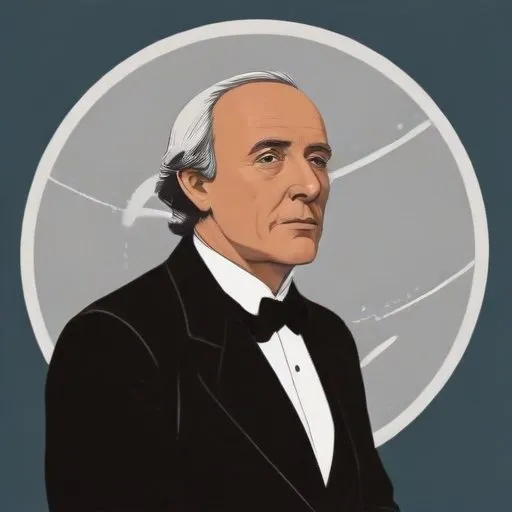
Discovered the white dwarf star Sirius B, a groundbreaking find that expanded our understanding of stellar evolution. This discovery paved the way for future research in astrophysics.
Alvan Graham Clark, an American astronomer and telescope maker, is renowned for being the first person to observe a white dwarf star, Sirius B, also affectionately known as the Pup. This groundbreaking discovery in 1862 proved an earlier hypothesis by Friedrich Wilhelm Bessel that Sirius, the brightest star in the night sky, had an unseen companion disturbing its motion.
Clark was born on July 10, 1832, in Fall River, Massachusetts, to Alvan Clark, founder of Alvan Clark & Sons, a prominent telescope-making company. Growing up in a family of telescope makers, Clark was exposed to the intricacies of telescope construction from a young age. He worked alongside his father, honing his skills and eventually taking over the family business.
On January 31, 1862, Clark made history by observing Sirius B, a white dwarf star, using an 18.5-inch refracting telescope lens in Cambridgeport, Massachusetts. This significance of this discovery lay in the confirmation of Bessel's earlier hypothesis, which had been a topic of debate among astronomers at the time.
Clark's work went beyond the discovery of Sirius B. He designed and built several notable telescopes, including the 18.5-inch refractor, which remained the largest in the United States for many years. His telescopes were delivered to prominent observatories, including the Dearborn Observatory of Northwestern University in Evanston, Illinois, where his telescope is still in use today.
Clark's contributions to astronomy paved the way for future generations of astronomers and telescope makers. His discovery of Sirius B and his innovative telescope designs left an indelible mark on the field of astronomy. Today, Clark is remembered as a pioneer who pushed the boundaries of human understanding of the universe.
Clark's personal life was marked by steady devotion to his work and family. He died on June 9, 1897, in Cambridge, Massachusetts, leaving behind a legacy of innovation and discovery.
Alvan Graham Clark's life and work serve as a testament to the power of innovation and curiosity, inspiring future generations of astronomers and scientists to push the boundaries of human knowledge.
Born in 1835
Developed innovative astronomical tables and made significant contributions to the field of mathematics, particularly in the areas of celestial mechanics and economics.
Born in 1885
Measured the galaxy's size and mapped the Milky Way's structure, revolutionizing our understanding of the universe.
Born in 1868
Founded the Mount Wilson Observatory, pioneered the field of astrophysics, and developed innovative telescopes, making groundbreaking discoveries about the sun and stars.
Born in 1863
Pioneering astronomer who classified over 350,000 stars and developed a system of stellar classification still used today. Her work paved the way for future astronomers to better understand the universe.
Born in 1857
A pioneering female astronomer who cataloged thousands of stars, discovered 59 gaseous nebulae, and developed a system for classifying stars based on their spectra. Her work laid the foundation for modern astrophysics.
Born in 1900
Pioneering astronomer who discovered that stars are primarily composed of hydrogen and helium, revolutionizing our understanding of the universe. Her groundbreaking work paved the way for future generations of astronomers.
Born in 1873
Developed the Hertzsprung-Russell diagram, a fundamental tool in astronomy that relates stars' brightness to their color and temperature. This diagram revolutionized our understanding of stars and their life cycles.
