


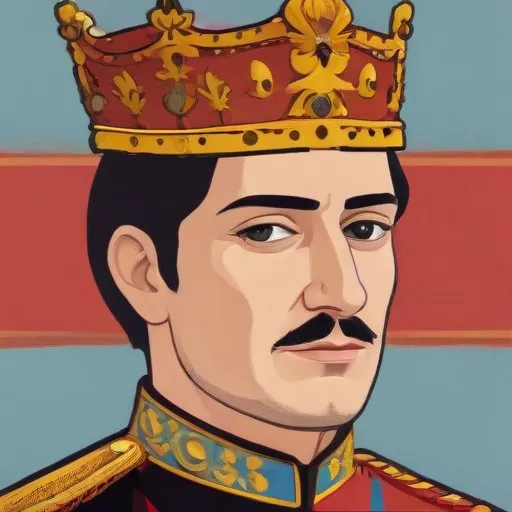
The first Spanish king from the House of Savoy, known for his brief but tumultuous reign marked by attempts to reform the government and military, ultimately leading to his abdication.
Amadeo I, also known as Amadeus, is remembered as the only king of Spain to hail from the House of Savoy, reigning from 1870 to 1873. His tumultuous tenure was marked by growing republicanism, Carlist rebellions, and the Cuban independence movement.
Born in Turin, Kingdom of Sardinia, on May 30, 1845, Amadeo was the second son of Victor Emmanuel II, the future King of a unified Italy, and Archduchess Adelaide of Austria. He was granted the hereditary title of Duke of Aosta from birth.
Amadeo entered the Royal Sardinian Army as a captain in 1859 and later fought in the Third Italian War of Independence in 1866, rising to the rank of major general. He led his brigade into action at the Battle of Custoza and was wounded at Monte Croce.
In 1867, he married Donna Maria Vittoria dal Pozzo, with whom he had three children. Following his marriage, he was created vice admiral of the Italian Royal Navy, a position he held until his ascension to the Spanish throne.
In 1870, Amadeo was elected by the Cortes Generales as Spain's monarch, following the deposition of Isabel II. He was sworn in the following year, marking the beginning of a tumultuous reign.
His time on the throne was marred by growing republicanism, Carlist rebellions in the north, and the Cuban independence movement. Despite his efforts to quell these uprisings, Amadeo's reign was ultimately cut short when he abdicated and returned to Italy in 1873.
Amadeo's abdication led to the declaration of the First Spanish Republic, marking a significant shift in Spain's political landscape. He founded the Aosta branch of Italy's royal House of Savoy, which is junior in agnatic descent to the branch descended from King Umberto I that reigned in Italy until 1946.
Despite the challenges he faced during his reign, Amadeo's legacy is one of resilience and adaptability. His experiences in Spain ultimately informed his later life, as he went on to play a significant role in Italian politics.
Amadeo's reign in Spain coincided with a period of great upheaval in Europe, as monarchies across the continent struggled to adapt to the rise of liberal democracies and nationalist movements. His experiences in Spain offer a unique lens through which to examine the challenges faced by European monarchies during this period.
Compared to his contemporaries, Amadeo's reign was marked by a sense of duty and obligation, rather than grand ambition or dynastic pride. His willingness to abdicate and return to Italy rather than cling to power distinguishes him from other European monarchs of the time.
Born in 1886
The last Bourbon king of Spain, ruling from 1886 to 1931, known for his tumultuous reign marked by political instability, economic struggles, and the loss of Spain's last colonies.
Born in 1830
Queen of Spain from 1833 to 1868, known for her tumultuous reign marked by political instability, corruption, and social unrest. She was eventually exiled to France after a revolution.
