


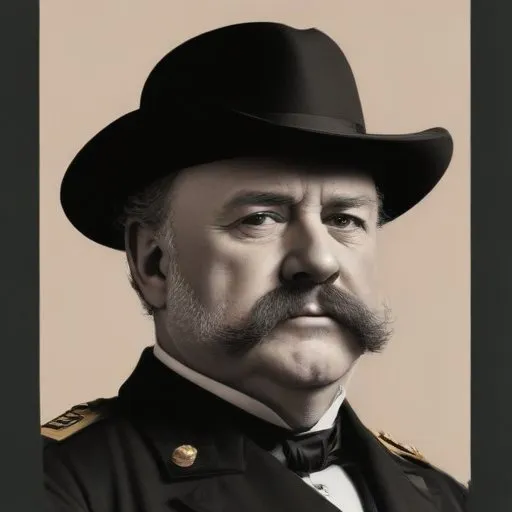
A Union general during the American Civil War, known for his distinctive sideburns and leading the Army of the Potomac to a disastrous defeat at the Battle of Fredericksburg.
Ambrose Burnside is best known for his tumultuous career as a senior Union general during the American Civil War, as well as his three-term governorship of Rhode Island. His military career was marked by early victories in the Eastern theater, but ultimately tarnished by two disastrous defeats at Fredericksburg and the Battle of the Crater at Petersburg.
Born on May 23, 1824, in Liberty, Indiana, Ambrose Burnside was the fourth of nine children to Edghill and Pamela Brown Burnside. His family had Irish and English roots, with his great-great-grandfather, Robert Burnside, settling in South Carolina in the 18th century. After his mother's death in 1841, Burnside was apprenticed to a local tailor, eventually becoming a partner in the business.
Before the Civil War, Burnside attended the United States Military Academy at West Point, graduating in 1847. He went on to serve in the Mexican-American War and later became a successful inventor and industrialist. During this period, he developed a carbine rifle that became widely adopted by the cavalry, although he was later robbed of the patent rights to his invention.
Burnside's early victories in the Eastern theater, including the Battle of Roanoke Island and the Battle of New Bern, earned him recognition and promotion. However, his later defeats at Fredericksburg and the Battle of the Crater at Petersburg led to his removal from command. Despite an inquiry clearing him of blame for the latter defeat, Burnside never regained his credibility as a military leader.
In his personal life, Burnside was known for his modesty and unassuming nature. His distinctive whiskers, which grew down the sides of his face, became known as "sideburns," derived from his surname. Burnside's romantic life was also marked by tragedy, as his fiancée, Charlotte "Lottie" Moon, left him at the altar and later became a Confederate spy during the Civil War.
Despite his military setbacks, Burnside remained committed to the Union cause and advocated for the abolition of slavery. His leadership style was characterized by a willingness to listen and adapt, although this approach sometimes led to hesitation and indecision on the battlefield.
Burnside's legacy extends beyond his military and political career. His invention of the carbine rifle contributed to the development of modern firearms, while his leadership during the Civil War shaped the course of American history. Furthermore, his distinctive whiskers have become an enduring cultural icon, symbolizing a bygone era of masculinity and style.
In the context of the American Civil War, Burnside's career serves as a reminder of the complexities and uncertainties of war. His story highlights the importance of effective leadership and adaptability in the face of adversity. As a historical figure, Burnside's legacy continues to fascinate and educate, offering valuable insights into the human experience during times of conflict and transformation.
In comparison to other Union generals, Burnside's leadership style was marked by caution and hesitation. While this approach led to defeats on the battlefield, it also reflected his willingness to listen and adapt to changing circumstances. In contrast to more aggressive leaders like Sherman and Grant, Burnside's approach was characterized by a more methodical and deliberate pace.
Born in 1822
Led the Union Army to victory in the Civil War and later became President, known for issuing the Emancipation Proclamation and strengthening federal authority.
Born in 1809
Led the United States through its Civil War and ultimately abolished slavery, leaving a lasting legacy in American history.
Born in 1826
A Union general during the American Civil War, he's infamous for his cautious tactics and disagreements with President Lincoln, later becoming a governor of New Jersey.
Born in 1820
A renowned Union general during the American Civil War, he's infamous for his scorched earth tactics and march through the Confederacy, leaving destruction in his wake.
Born in 1815
Led the Union Army to victory in the Battle of Gettysburg, a turning point in the American Civil War, and later oversaw the construction of the Washington Aqueduct.
Born in 1814
Union general who played a crucial role in the American Civil War, particularly at the Battle of Chancellorsville and Gettysburg.
Born in 1826
Union cavalry officer who played a crucial role in the Battle of Gettysburg, delaying Confederate forces and allowing Union troops to establish a strong defensive position .
Born in 1828
A heroic figure who led the 20th Maine Infantry Regiment to victory at Gettysburg, and later served as Governor of Maine, known for his bravery and leadership during the American Civil War.
