


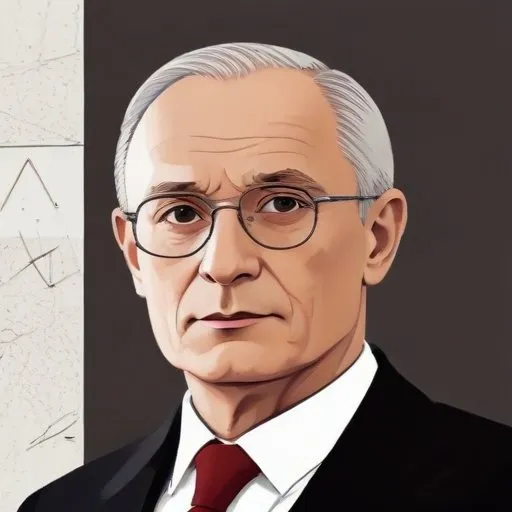
A Russian mathematician and academic who developed the New Chronology theory, which challenges traditional historical dating and proposes a revised timeline of human history.
Anatoly Timofeevich Fomenko is a renowned Russian mathematician and professor at Moscow State University, known for his work in topology and his membership in the Russian Academy of Sciences. However, he is also widely recognized for his controversial theories on history, collectively known as New Chronology, which have sparked intense debates among scholars and the general public alike.
Anatoly Fomenko was born on March 13, 1945, in Stalino, USSR (now Donetsk, Ukraine) to Timothy Grigorievich Fomenko, an industrial engineer, and Valentina Polikarpovna, a philologist and teacher of Russian language and literature. His parents would later collaborate with him on his work on New Chronology.
Fomenko grew up in Magadan and later moved to Luhansk, where he attended Secondary School No. 26. During his school years, he developed a passion for mathematics and won several medals in competitions. He also had his first science fiction story, "The Mystery of the Milky Way," published in the magazine Pionerskaya Pravda in 1959.
Fomenko graduated from the Mechanics and Mathematics Department of Moscow State University in 1967 and went on to study differential geometry in the same department. He defended his thesis, "Classification of totally geodesic manifolds realizing nontrivial cycles in Riemannian homogeneous spaces," in 1970, and his doctoral thesis, "The decision of the multidimensional plateau problems on Riemannian manifolds," in 1972.
Fomenko's work in topology has been highly influential, with a focus on the study of topological objects and structures. He has published numerous papers on the subject and has been recognized for his contributions to the field.
Aside from his work in mathematics, Fomenko is also a skilled painter and illustrator, creating original artworks inspired by topological objects and structures. His art is a testament to the beauty and complexity of mathematical concepts.
Fomenko's most notable work, however, is his development of New Chronology, a pseudoscientific theory that challenges the traditional understanding of history. He argues that the conventional timeline of human history is incorrect and that many historical events have been fabricated or distorted.
Fomenko's theory is based on the works of Russian-Soviet writer Nikolai Alexandrovich Morozov and proposes a revised timeline of human history, with many events occurring centuries later than commonly believed. The theory has sparked intense debates among historians, scholars, and the general public, with many criticizing it as unfounded and lacking in evidence.
Fomenko's work, both in mathematics and New Chronology, has had a significant impact on modern society. While his theories have been met with skepticism, they have also inspired a new generation of thinkers and researchers to question the status quo and challenge conventional wisdom.
As a prominent figure in Russian academia, Fomenko has also made significant contributions to the field of education, inspiring students and young scholars to pursue careers in mathematics and science.
Fomenko's theory of New Chronology has been widely criticized for lacking scientific evidence and methodology. Many historians and scholars have accused him of cherry-picking data and ignoring contradictory evidence to support his claims.
Despite the controversy surrounding his theories, Fomenko remains a respected figure in Russian academia and continues to teach and research at Moscow State University.
Fomenko's parents, who were both involved in his work on New Chronology, have been a significant source of support and inspiration throughout his career.
Fomenko's artistic talents extend beyond mathematics and painting, as he has also written science fiction stories, including "The Mystery of the Milky Way," which was published in 1959.
In conclusion, Anatoly Fomenko is a complex and multifaceted figure, known for his significant contributions to mathematics and his controversial theories on history. Love him or hate him, Fomenko has left an indelible mark on modern society and continues to inspire and provoke thinkers around the world.
Born in 1903
Developed theories on probability, topology, and complexity, making significant contributions to modern mathematics and computer science.
88 Years Old
A renowned mathematician and academic, he was awarded the Fields Medal for his groundbreaking contributions to topology and algebraic geometry. His work has far-reaching implications for our understanding of geometric structures.
89 Years Old
A renowned mathematician and academic who made significant contributions to the fields of differential equations, dynamical systems, and symplectic geometry, earning him numerous awards and honors.
Born in 1856
Developed the theory of Markov chains, a mathematical system that undergoes transitions from one state to another, and is widely used in computer science, biology, and economics.
Born in 1923
A Russian mathematician and theorist who made significant contributions to algebraic geometry and number theory, and is also known for his philosophical and political writings.
89 Years Old
A renowned mathematician and academic who made significant contributions to number theory, algebraic geometry, and mathematical physics, particularly in the development of modular forms and their applications.
