


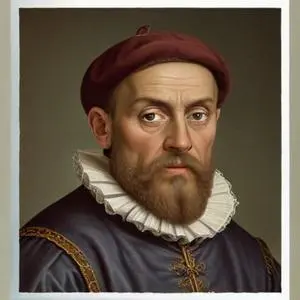
A pioneering figure in the study of human anatomy, known for performing detailed dissections and creating accurate drawings of the body's inner workings, revolutionizing medical understanding.
Andreas Vesalius, a renowned Flemish anatomist and physician, is celebrated for his groundbreaking work, De Humani Corporis Fabrica Libri Septem (On the Fabric of the Human Body in Seven Books), which revolutionized the field of human anatomy. This seminal work, published in 1543, is considered one of the most influential books on the subject, superseding the long-dominant teachings of Galen.
Vesalius was born on December 31, 1514, in Brussels, which was then part of the Habsburg Netherlands. His family had a rich tradition in medicine, with his great-grandfather, Jan van Wesel, teaching medicine at the University of Leuven, and his father, Anders van Wesel, serving as apothecary to Emperor Maximilian and later as valet de chambre to Charles V.
Vesalius's interest in anatomy was sparked during his studies at the University of Paris, where he examined excavated bones in the charnel houses at the Cemetery of the Innocents. He was deeply influenced by the teachings of Galen, but soon became disillusioned with the inaccuracies in Galen's work.
Vesalius's magnum opus, De Humani Corporis Fabrica Libri Septem, is a comprehensive and accurate description of the human body. This work is notable for its detailed descriptions of the human skeleton, muscles, and organs, accompanied by meticulous illustrations. Vesalius's work corrected many of Galen's errors and introduced new concepts, such as the concept of the "fabric" of the human body.
His work had a profound impact on the field of anatomy, paving the way for future generations of anatomists and physicians. Vesalius's emphasis on direct observation and hands-on dissection revolutionized the way anatomy was taught and practiced.
Vesalius's work had far-reaching consequences, influencing the development of modern medicine, surgery, and scientific inquiry. His emphasis on empirical observation and experimentation laid the groundwork for the scientific method.
Today, Vesalius is regarded as the father of modern human anatomy, and his work continues to inspire and inform medical professionals, researchers, and students around the world.
Vesalius's legacy extends beyond the realm of anatomy and medicine. His pioneering spirit, curiosity, and dedication to seeking knowledge have made him a timeless inspiration to scholars and scientists across disciplines.
In conclusion, Andreas Vesalius's groundbreaking work and contributions to the field of human anatomy have left an indelible mark on the history of science and medicine. His legacy continues to inspire and educate generations of scholars, researchers, and medical professionals.
Born in 1564
Pioneering astronomer, physicist, and mathematician who played a major role in the Scientific Revolution, making key discoveries that challenged Aristotelian views and laid the foundation for modern science.
Born in 1452
Renaissance mastermind behind iconic works like the Mona Lisa and The Last Supper, who revolutionized art, science, and engineering with his inventive and curious nature.
Born in 1578
Discovered the circulatory system and described how blood flows through the body, revolutionizing understanding of human physiology.
Born in 1537
Italian anatomist who pioneered embryology, discovering the bony casing of the fetus and describing the placenta's role in nourishing the developing embryo.
