


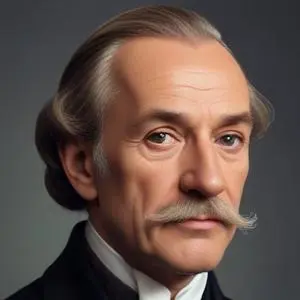
Discovered the circulatory system and described how blood flows through the body, revolutionizing understanding of human physiology.
William Harvey, an English physician, is renowned for being the first to describe the circulatory system and the concept of blood circulation, revolutionizing our understanding of human anatomy and physiology. His groundbreaking work, De Motu Cordis, published in 1628, laid the foundation for modern cardiology and forever changed the course of medical history.
William Harvey was born on April 1, 1578, in Folkestone, Kent, England, to Thomas Harvey, a jurat of Folkestone, and his wife Joan Halke. He was the eldest of nine children, including seven sons and two daughters. Harvey's early education took place in Folkestone, where he learned Latin, before moving on to the King's School in Canterbury.
In 1593, Harvey matriculated at Gonville and Caius College, Cambridge, where he graduated with a Bachelor of Arts degree in 1597. His academic pursuits then took him to the University of Padua, Italy, where he earned his Doctor of Medicine degree in 1602.
During his time at the University of Padua, Harvey developed a close relationship with Fabricius, a renowned anatomist, and read his work, De Venarum Ostiolis. This exposure sparked Harvey's interest in the circulatory system, leading him to conduct extensive research and experimentation.
Harvey's pioneering work, De Motu Cordis, presented a comprehensive description of the circulatory system, explaining how the heart pumps blood throughout the body. This groundbreaking discovery challenged the prevailing views of the time, which attributed the liver as the center of blood circulation.
Harvey's discovery of blood circulation has had a profound impact on modern medicine, paving the way for significant advances in cardiology, surgery, and pharmaceuticals. His work has also inspired generations of scientists, physicians, and researchers, shaping the course of medical research and practice.
Harvey's contributions to medicine have been recognized and celebrated through various honors and accolades, including:
William Harvey's groundbreaking discovery of blood circulation has left an indelible mark on the field of medicine, cementing his legacy as one of the most influential figures in the history of physiology.
Born in 1514
A pioneering figure in the study of human anatomy, known for performing detailed dissections and creating accurate drawings of the body's inner workings, revolutionizing medical understanding.
Born in 1596
Developed influential philosophical and mathematical concepts, including the famous phrase "I think, therefore I am," and laid the foundation for modern Western philosophy.
Born in 1561
A 16th-17th century Renaissance figure who pioneered the scientific method and empiricism, and served as a prominent government official.
Born in 1889
Discovered galaxies beyond our own Milky Way, revolutionizing our understanding of the universe's scale and expansion. Pioneered observational cosmology, providing evidence for the Big Bang theory.
Born in 1809
Developed the theory of evolution through natural selection, revolutionizing our understanding of life on Earth. This groundbreaking idea transformed the fields of biology, ecology, and beyond.
