


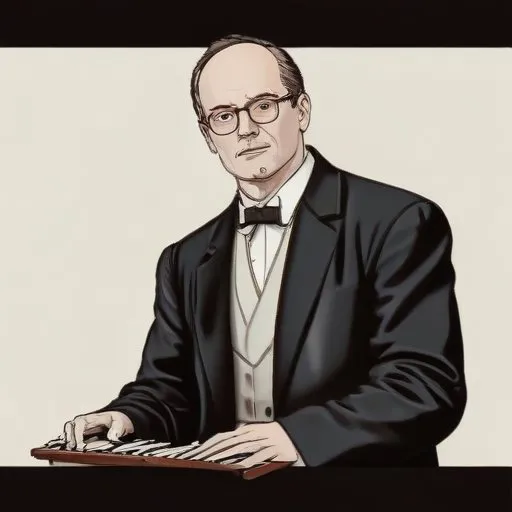
A renowned Baroque-era musician and theorist who wrote influential treatises on music theory, harmony, and organ tuning, shaping the course of Western classical music.
Andreas Werckmeister, a German organist, music theorist, and composer, is credited with developing a temperament that enabled all tonalities to sound acceptable on the keyboard, paving the way for Western music's harmonic foundation. His groundbreaking work, particularly his conceptualization of well temperament, has had a profound impact on the evolution of music, influencing legendary composers like Johann Sebastian Bach.
Born on November 30, 1645, in Benneckenstein, Werckmeister received his early education in Nordhausen and Quedlinburg. His musical training was facilitated by his uncles, Heinrich Christian Werckmeister and Heinrich Heinrich Victor Werckmeister.
Although many of Werckmeister's compositions have been lost to time, a few notable works remain. His booklet, Musikalische Privatlust (1689), features pieces for violin with basso continuo. Additionally, some of his organ works have survived, including Canzon in a minor, Canzona in d minor, Praeludium ex G, and Canzonetta in D major.
Werckmeister's most significant contribution to music lies in his theoretical works. His publications, Musicae mathematicae hodegus curiosus... (1687) and Musikalische Temperatur (1691), introduced the concept of well temperament, which distributes the comma (a small interval) to the four fifths GD, DA, AE, and BF, making all keys playable. This innovation has come to be known as Werckmeister temperament.
Werckmeister's ideas on counterpoint, particularly invertible counterpoint, resonated with Johann Sebastian Bach, who was heavily influenced by his work. Werckmeister's unique perspective on music, which drew parallels between counterpoint and the orderly movements of the planets, echoes Kepler's views in Harmonice Mundi. This has led musicologist George Buelow to remark that no other writer of the period regarded music as unequivocally tied to the natural world.
Werckmeister's work demonstrates a deep understanding of the mathematical and theoretical foundations of music. His emphasis on the connection between music and the natural world reveals a philosophical perspective that transcends the boundaries of art and science.
Through his groundbreaking work, Andreas Werckmeister has left an indelible mark on the world of music, inspiring generations of composers and theorists to explore the harmonious possibilities of the well-tempered keyboard.
Born in 1685
A master of Baroque music, he composed over 1,000 works, including orchestral suites, cantatas, and passions, that still inspire and influence musicians today. His innovative use of counterpoint and harmony raised the bar for classical music.
Born in 1685
A renowned Baroque composer and organist, famous for creating majestic orchestral suites, operas, and oratorios, including the iconic "Messiah" masterpiece.
Born in 1833
A renowned pianist and composer, he crafted complex, expressive works that blended traditional and innovative techniques, leaving an indelible mark on classical music.
Born in 1809
A renowned 19th-century musician who masterfully blended classical and romantic styles, creating iconic works like the "Wedding March" and "Elijah" oratorio. His compositions continue to inspire and influence generations of artists.
Born in 1810
A renowned Romantic-era composer and influential music critic, known for his expressive and emotionally charged works, including symphonies, piano music, and art songs.
Born in 1811
A virtuosic pianist and composer who revolutionized classical music with his technically demanding and emotionally expressive works, blending Hungarian folk influences with Romantic-era drama.
Born in 1678
A virtuosic violinist and prolific composer, he crafted over 400 concertos, including "The Four Seasons," which remains a beloved and iconic masterpiece of classical music.
