


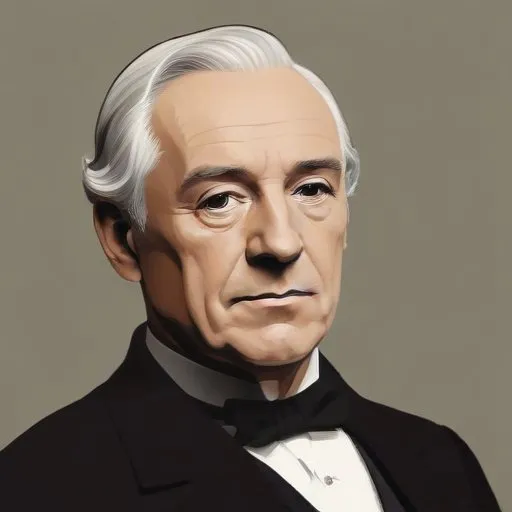
Co-founder of Cornell University, a pioneering historian, and diplomat who shaped American education and foreign policy. Known for his groundbreaking work in historical research and academic innovation.
Andrew Dickson White is renowned for co-founding Cornell University, one of the prestigious Ivy League universities in the United States, and serving as its first president for nearly two decades. He is also recognized for his groundbreaking work in expanding the scope of college curricula and his influential book, "A History of the Warfare of Science with Theology in Christendom," which explored the historical conflict between science and religion.
Andrew Dickson White was born on November 7, 1832, in Homer, New York, to Clara (née Dickson) and Horace White. His father, Horace, was a successful businessman and wealthy merchant who had overcome poverty and lack of formal education to open the Syracuse Savings Bank in 1839. White's early life was marked by a strong sense of ambition and a desire for knowledge, which led him to enroll at Geneva College (now Hobart and William Smith Colleges) in 1849.
White's academic pursuits led him to become a historian and educator of great repute. He was instrumental in establishing Cornell University in 1865, along with Senator Ezra Cornell, and served as its first president until 1885. During his tenure, White worked tirelessly to expand the university's curriculum, introducing new subjects such as biology, chemistry, and modern languages.
His commitment to education and historical research also led him to write "A History of the Warfare of Science with Theology in Christendom," a monumental work that explored the historical conflict between science and religion. The book, published in 1896, consisted of approximately 800 pages and was a testament to White's dedication to understanding the complex relationship between science and faith.
White's work on the conflict thesis, which posits that science and religion have historically been in conflict, has had a profound impact on our understanding of the relationship between faith and reason. His philosophical contributions have also shaped the way we approach education, emphasizing the importance of a broad-based curriculum that includes both the sciences and the humanities.
Andrew Dickson White's contributions to education and historical research have been recognized with several awards and honors, including:
Andrew Dickson White's legacy extends far beyond his academic pursuits and public service. He has left an indelible mark on the world of education, inspiring generations of scholars and researchers to explore the complex relationships between science, religion, and society. His commitment to expanding the scope of college curricula has had a lasting impact on the way we approach education, emphasizing the importance of interdisciplinary studies and critical thinking.
Today, Cornell University stands as a testament to White's vision and dedication to education, and his work continues to inspire new generations of scholars and researchers to explore the complexities of our world.
Born in 1856
The 28th President of the United States, a Nobel Peace Prize winner, and a historian who played a key role in shaping international relations and global governance after World War I. He's most known for his idealistic vision of a League of Nations and his efforts to promote peace and diplomacy.
Born in 1858
A pioneering leader who championed progressive reforms, trust-busting, and conservation, earning a Nobel Peace Prize for mediating the Russo-Japanese War. He's also famous for his rugged outdoorsmanship and "big stick" diplomacy.
Born in 1845
A prominent lawyer and politician who served as Secretary of State, earning a Nobel Peace Prize for his diplomatic efforts. He's most known for his work in international arbitration and conflict resolution.
Born in 1850
A prominent historian and politician who served as a U.S. Senator and was a key figure in the development of the U.S. foreign policy, particularly in the early 20th century.
82 Years Old
A German-Canadian singer-songwriter, guitarist, and producer, known for his eclectic style blending rock, folk, and blues, and as the frontman of the rock band Steppenwolf. He's famous for hits like "Born to Be Wild" and "Magic Carpet Ride".
Born in 1857
The 27th President of the United States was a lawyer and jurist who served as the only person to hold the offices of President and Chief Justice of the United States. He's known for his significant contributions to the country's judicial system.
Born in 1874
The 31st President of the United States was a humanitarian and politician who led the country through the Great Depression and is known for his humanitarian efforts and infrastructure development. He's also infamous for his inability to mitigate the economic crisis.
Born in 1872
The 30th President of the United States, a lawyer and politician, led the country through a period of economic prosperity and limited government intervention, earning the nickname "Silent Cal" for his frugal and humble nature. He's most known for his minimalist approach to governance and tax cuts.
