


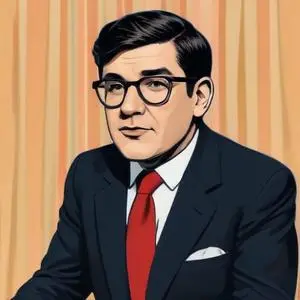
Founder of the UK's National Health Service (NHS), credited with providing universal healthcare to all citizens. A pioneer in socialized medicine, his legacy continues to shape healthcare policies worldwide.
Aneurin Bevan is widely regarded as one of the most influential left-wing politicians in British history, best known for spearheading the creation of the British National Health Service (NHS) as Minister of Health in Clement Attlee's government. His tireless efforts to provide universal healthcare to all citizens of the United Kingdom have left an indelible mark on the country's welfare state.
Born on November 15, 1897, in Tredegar, Monmouthshire, Wales, Bevan was the son of a coal miner and was raised in a working-class family. He left school at the age of 14 and went on to work as a miner, where he became involved in local miners' union politics.
Bevan's early involvement in politics led him to become the head of his Miners' Lodge at the age of 19, where he frequently railed against management. He later joined the Labour Party and attended the Central Labour College in London.
After returning to South Wales, Bevan struggled to find work, remaining unemployed for nearly three years before gaining employment as a union official. This experience led him to become a leading figure in the 1926 general strike.
In 1928, Bevan won a seat on Monmouthshire County Council, and the following year, he was elected as the MP for Ebbw Vale, a position he held for 31 years.
In Parliament, Bevan became a vocal critic of numerous other politicians from all parties, particularly Winston Churchill and David Lloyd George. During World War II, Bevan used his platform to criticize Churchill's government, arguing that the war effort was being mishandled.
In 1945, Bevan was chosen as the Minister of Health in Clement Attlee's new Labour government, becoming the youngest member of the cabinet at 47. Inspired by the Tredegar Medical Aid Society in his hometown in South Wales, Bevan led the campaign for a National Health Service, which was eventually established in 1948.
Bevan's legacy extends far beyond his role in creating the NHS. He is widely regarded as one of the founders of the British welfare state, and his influence can be seen in many aspects of modern British society.
Aneurin Bevan's life and work serve as a testament to the power of dedication, hard work, and a commitment to making a difference in the lives of others.
Born in 1883
Led the Labour Party to a landslide victory in 1945, implementing significant social and economic reforms, including the creation of the National Health Service. He played a crucial role in shaping post-war Britain.
Born in 1885
Won the 1952 Olympic Games marathon in Helsinki, Finland, and held the world record in the marathon from 1952 to 1953.
Born in 1925
A pioneering politician who championed socialism and workers' rights, known for his radical views and advocacy for nationalization of key industries.
Born in 1913
A British Labour Party leader and passionate orator who championed workers' rights and opposed nuclear proliferation. He's remembered for his strong socialist stance and charismatic leadership style.
84 Years Old
A Welsh politician who served as Vice-President of the European Commission, known for his efforts to reform the European Union and promote social democracy. He's a prominent figure in British politics, leading the Labour Party in the 1980s.
75 Years Old
The Prime Minister of the United Kingdom from 2007 to 2010, known for his key role in shaping the country's economy and response to the 2008 global financial crisis.
73 Years Old
The former Prime Minister of the United Kingdom who led the country through a transformative period, including the Iraq War, and is known for his charismatic leadership and controversial decisions.
56 Years Old
A British politician who served as Minister for the Cabinet Office and Leader of the Opposition, known for his progressive policies and climate change advocacy.
