


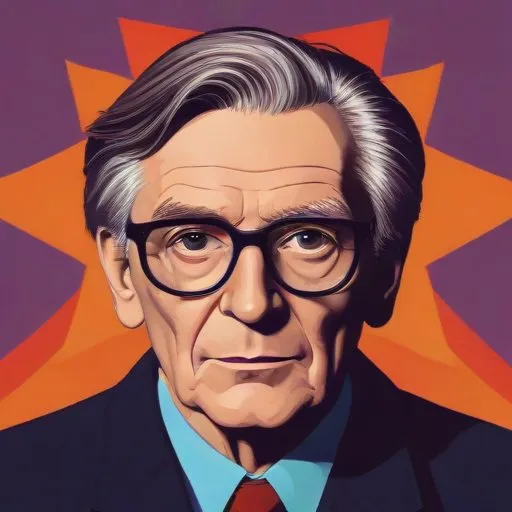
A British Labour Party leader and passionate orator who championed workers' rights and opposed nuclear proliferation. He's remembered for his strong socialist stance and charismatic leadership style.
Michael Foot, a British politician who led the Labour Party from 1980 to 1983, is known for his unwavering commitment to social justice, nuclear disarmament, and European integration. As a passionate orator and dedicated leader, Foot left an indelible mark on British politics, leaving behind a legacy that continues to inspire and influence generations to come.
Born on July 23, 1913, in Plymouth, Devon, Foot was the fourth son of Isaac Foot, a solicitor, and Eva Mackintosh. He began his career as a journalist, working for Tribune and the Evening Standard, where he developed his writing skills and honed his critical thinking. In 1940, Foot coauthored the polemic "Guilty Men," a scathing critique of the British government's appeasement policy towards Nazi Germany, under the pseudonym "Cato."
Foot's entry into politics began in 1945, when he was elected as a Member of Parliament (MP) for the Plymouth Devonport constituency. He served in this capacity until 1955 and again from 1960 to 1992. Throughout his career, Foot was an ardent supporter of the Campaign for Nuclear Disarmament (CND) and advocated for British withdrawal from the European Economic Community (EEC). His strong left-wing political positions and criticisms of his vacillating leadership made him a polarizing figure, earning him the nickname "Worzel Gummidge" for his rumpled appearance.
In 1974, Foot was appointed Employment Secretary in Harold Wilson's Cabinet, a position he held until 1976. He later served as Leader of the House of Commons under James Callaghan from 1976 to 1979 and as Deputy Leader of the Labour Party under Callaghan from 1976 to 1980. In 1980, Foot was elected as the Leader of the Labour Party, a position he held until 1983.
As Labour leader, Foot faced criticism for his leadership style, which was seen as vacillating and ineffective. His strong left-wing stance and advocacy for nuclear disarmament led to divisions within the party, and a faction broke away in 1981 to form the Social Democratic Party (SDP). Foot led Labour into the 1983 general election, which resulted in the party's lowest share of the vote in 65 years and the fewest parliamentary seats since 1935. He resigned the party leadership following the election and was succeeded by Neil Kinnock.
Despite his controversial leadership, Foot's commitment to social justice and his unwavering advocacy for nuclear disarmament continue to inspire generations of politicians and activists. In his personal life, Foot was married to Jill Craigie, a filmmaker, and had three children. He passed away on March 3, 2010, at the age of 96, leaving behind a legacy that continues to shape British politics.
Foot was known for his eloquence and wit, and his quotes continue to inspire and motivate. Some of his most memorable sayings include:
Michael Foot's life and legacy serve as a testament to the power of dedication, passion, and commitment to social justice. His unwavering advocacy for nuclear disarmament and European integration continues to inspire generations, and his commitment to social justice remains a beacon of hope for a better future.
Born in 1925
A pioneering politician who championed socialism and workers' rights, known for his radical views and advocacy for nationalization of key industries.
84 Years Old
A Welsh politician who served as Vice-President of the European Commission, known for his efforts to reform the European Union and promote social democracy. He's a prominent figure in British politics, leading the Labour Party in the 1980s.
75 Years Old
The Prime Minister of the United Kingdom from 2007 to 2010, known for his key role in shaping the country's economy and response to the 2008 global financial crisis.
73 Years Old
The former Prime Minister of the United Kingdom who led the country through a transformative period, including the Iraq War, and is known for his charismatic leadership and controversial decisions.
Born in 1885
Won the 1952 Olympic Games marathon in Helsinki, Finland, and held the world record in the marathon from 1952 to 1953.
Born in 1912
A British politician who served as Prime Minister from 1976 to 1979, known for his efforts to stabilize the economy and navigate the country through a period of industrial unrest.
93 Years Old
A prominent Labour Party figure, serving as Shadow Home Secretary, known for his strong stances on social justice and welfare reform.
Born in 1917
A British politician who served as Chancellor of the Exchequer from 1974 to 1979, known for his efforts to stabilize the UK's economy during a period of high inflation and economic crisis.
