


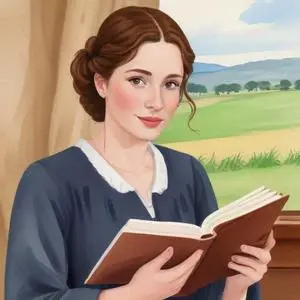
Anne Brontë, the lesser-known but equally talented sister of the renowned Brontë literary family, left an indelible mark on English literature with her thought-provoking novels and poignant poetry. Known for her fearless exploration of social conventions, women's rights, and moral dilemmas, Brontë's works continue to inspire and captivate readers to this day.
Born on January 17, 1820, in Thornton, Yorkshire, England, Anne was the youngest of six siblings, including her famous sisters Charlotte and Emily. Their father, Patrick Brontë, was a clergyman in the Church of England, and their mother, Maria Branwell Brontë, was a homemaker. Anne's early life was marked by tragedy, with her mother's death in 1821, followed by the passing of her two older sisters, Maria and Elizabeth, in 1825.
In 1846, Anne, along with her sisters Charlotte and Emily, published a collection of poetry under the male pseudonyms Currer, Ellis, and Acton Bell, respectively. However, it was Anne's novels that truly showcased her literary prowess. Her first novel, Agnes Grey, published in 1847, offered a scathing critique of the treatment of governesses and the limited options available to women during that era.
Her second and final novel, The Tenant of Wildfell Hall, published in 1848, is often regarded as one of the first feminist novels. This groundbreaking work tackled themes of domestic violence, female economic independence, and the struggle for moral integrity in the face of societal expectations. Despite its controversy, the novel has become a beloved classic of English literature.
Anne's life was marked by periods of poverty, hardship, and personal struggle. She worked as a governess, a position that inspired her writing, but also took a toll on her health. Her experiences as a governess deeply influenced her writing, as she drew upon her own struggles to craft characters and storylines that continue to resonate with readers today.
Anne Brontë's literary legacy extends far beyond her own lifetime. Her novels have inspired generations of writers, including George Eliot and Elizabeth Gaskell, and continue to be studied and admired by scholars and readers alike.
Despite her short life, Brontë's contributions to literature have left an indelible mark on the literary canon. Her unwavering commitment to exploring the complexities of human nature, her unflinching critique of societal norms, and her relentless pursuit of literary excellence have cemented her place as one of the most important and innovative writers of her time.
Anne Brontë's remarkable life, marked by literary achievements, personal struggles, and an unwavering commitment to her art, serves as a testament to the power of the human spirit. Her groundbreaking novels and poetry continue to inspire, provoke, and captivate readers, ensuring her place as an enduring and influential voice in English literature.
Born in 1818
Wrote classic novels and poetry that explored the human experience, particularly in the context of love, family, and the natural world.
Born in 1816
Author of classic novels like Jane Eyre, exploring themes of love, identity, and social class in 19th-century England. Her works remain beloved for their strong female protagonists and gothic atmosphere.
Born in 1817
A talented but troubled artist, known for his vivid portraits and tumultuous life, which overshadowed his literary and artistic contributions.
Born in 1810
A pioneering novelist of the Victorian era, known for her insightful portrayals of social class and women's lives in industrial England, particularly in her novel "North and South".
Born in 1811
Satirical novelist and illustrator of Victorian society, known for his witty and insightful portrayals of the English upper class, particularly in his novel "Vanity Fair".
Born in 1812
A renowned author of timeless classics, crafting vivid stories that exposed social injustices and explored the human condition, leaving an indelible mark on literature.
Born in 1819
A renowned 19th-century English novelist and poet, celebrated for crafting complex, psychologically nuanced characters and exploring social issues in works like "Middlemarch" and "Silas Marner".
