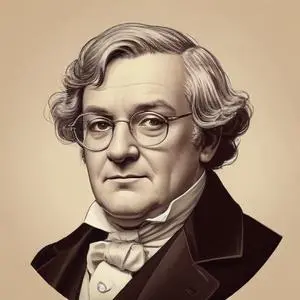
William Makepeace Thackeray

William Makepeace Thackeray

William Makepeace Thackeray was born on July 18th, 1811

Full Name: William Makepeace Thackeray
Occupation: Author, Poet
Nationality: English
Birthplace: Calcutta, British India
Notable: Vanity Fair
Style: Realism
Fields: Literature, Satire
Role: Novelist

Satirical novelist and illustrator of Victorian society, known for his witty and insightful portrayals of the English upper class, particularly in his novel "Vanity Fair".

William Makepeace Thackeray: The Satirical Mastermind of Victorian Literature

Early Life and Literary Beginnings

William Makepeace Thackeray, born on July 18, 1811, in Calcutta, British India, is renowned for his scathing satirical works that pierced the veil of British society during the Victorian era. His literary mastery is exemplified in his iconic novel, Vanity Fair (1847-1848), a sweeping portrait of British society, and The Luck of Barry Lyndon (1844), which was adapted into a film by Stanley Kubrick in 1975.

Thackeray's early life was marked by tragedy when his father, Richmond Thackeray, passed away in 1815. Subsequently, he was sent to England and educated at various schools, including Charterhouse and Trinity College, Cambridge. However, he left Cambridge without a degree and embarked on a journey across Europe, fostering his artistic skills and developing his literary inclinations.

Career Highlights and Major Works

Thackeray's literary career commenced with satirical sketches, such as The Yellowplush Papers, which showcased his affinity for roguish characters. His writing style matured over time, and he became synonymous with his scathing attacks on high society, military prowess, marriage, and hypocrisy. Some of his notable works include:

Influence on Modern Society

Thackeray's works not only reflected the societal norms of his time but also influenced the literary landscape of the Victorian era. His novels often critiqued the social conventions, highlighting the hypocrisies of the upper class. His influence can be seen in the works of contemporary writers, such as Charles Dickens, with whom he shared a complex relationship.

Personal Milestones and Key Life Events

Thackeray's personal life was marked by struggle and tragedy. He squandered much of his inheritance on gambling and unsuccessful business ventures, leading him to take up journalism to support his family. His wife, Isabella, suffered from mental illness, leaving Thackeray a de facto widower. Despite these challenges, he continued to write, eventually gaining fame with the publication of Vanity Fair.

Philosophical Contributions and Beliefs

Thackeray's works often reflected his philosophical stance on society, morality, and the human condition. He believed in the importance of social critique, using satire as a tool to expose the flaws of the upper class. His works often showcased his distaste for hypocrisy, particularly in the realms of politics and high society.

Awards and Honors

During his lifetime, Thackeray was recognized for his literary contributions, although he never received any formal awards or honors. His literary prowess, however, has been recognized by posterity, and he remains one of the most celebrated writers of the Victorian era.

Legacy and Historical Context

Thackeray's legacy is complex, reflecting both the virtues and flaws of his time. His works continue to be celebrated for their biting satire, nuanced characterization, and piercing social commentary. As a writer, he played a significant role in shaping the literary landscape of the Victorian era, leaving behind a body of work that continues to captivate and inspire readers to this day.

Thackeray's life came to an end on December 24, 1863, when he succumbed to a stroke at the age of 52. Despite his tumultuous life, his literary legacy endures, serving as a testament to his genius and his unwavering commitment to satire and social critique.

Timeline
1811
Born in Calcutta, India
William Makepeace Thackeray was born on July 18, 1811, in Calcutta, India, to a British family. He would go on to become one of the most renowned English novelists of the 19th century.
1837
Moved to London to Study Law
Thackeray moved to London to study law at the University of Cambridge, but he soon became disenchanted with the subject and began to focus on writing instead.
1847
Published First Novel, The Book of Snobs
Thackeray published his first novel, The Book of Snobs, which became a moderate success. This marked the beginning of his literary career.
1852
Published Vanity Fair
Thackeray published his most famous novel, Vanity Fair, which became a huge commercial and critical success. The novel is still widely read and adapted today.
1863
Died on Christmas Eve
William Makepeace Thackeray died on Christmas Eve, 1863, at the age of 52. He left behind a legacy as one of the greatest English novelists of all time.
William Makepeace Thackeray

William Makepeace Thackeray Quiz

What is the primary focus of William Makepeace Thackeray's novels?

Score: 0/5
FAQ
What is William Makepeace Thackeray best known for?
William Makepeace Thackeray is best known for his novels of social satire, particularly Vanity Fair, which is considered one of the greatest novels of the 19th century.
What was William Makepeace Thackerays writing style like?
William Makepeace Thackerays writing style was characterized by his use of satire, irony, and social commentary. He is known for his witty dialogue and his ability to create vivid characters.
What was William Makepeace Thackerays view on Victorian society?
William Makepeace Thackeray was critical of the social conventions and hypocrisies of Victorian society. He used his writing to satirize the excesses and superficiality of the upper class.
How did William Makepeace Thackerays work influence later writers?
William Makepeace Thackerays work influenced later writers such as Charles Dickens and Thomas Hardy, who also wrote about social issues and the human condition.
What was William Makepeace Thackerays early life like?
William Makepeace Thackerays early life was marked by financial instability and family tragedy. He was born in India and educated in England, and later studied art and law before turning to writing.

Related People:

Charles Dickens

Born in 1812

A renowned author of timeless classics, crafting vivid stories that exposed social injustices and explored the human condition, leaving an indelible mark on literature.

Jane Austen

Born in 1775

A celebrated author of witty, romantic novels of manners that offer insightful commentary on 19th-century English society, particularly the lives of women. Her works remain beloved for their strong female characters, clever dialogue, and nuanced exploration of relationships.

Mary Shelley

Born in 1797

Author of Gothic novels, particularly the iconic "Frankenstein", which has become a cultural phenomenon and influenced countless adaptations and reinterpretations.

Percy Bysshe Shelley

Born in 1792

Romantic-era writer of lyrical poetry and Gothic dramas that explored the human condition, freedom, and the beauty of nature.

Lord Byron

Born in 1788

Romantic poet and playwright celebrated for passionate, expressive works that explored themes of love, freedom, and the human condition.

John Keats

Born in 1795

Romantic poet celebrated for sensual language and vivid imagery, capturing the beauty of nature and human experience in odes like "To Autumn" and "Ode to a Nightingale".

Elizabeth Gaskell

Born in 1810

A pioneering novelist of the Victorian era, known for her insightful portrayals of social class and women's lives in industrial England, particularly in her novel "North and South".

Anthony Trollope

Born in 1815

A prolific writer of novels, essays, and short stories, known for his insightful portrayals of Victorian society and politics. His works are still widely read and adapted today.