


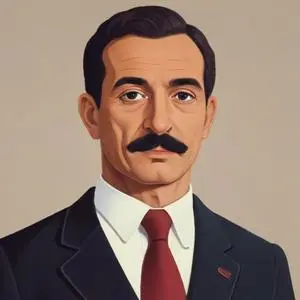
A dictator who ruled Portugal from 1933 to 1968, implementing a corporatist authoritarian regime and maintaining a neutral stance during World War II. He's known for his economic reforms and nationalist policies.
António de Oliveira Salazar, a Portuguese statesman, academic, and economist, is best known for serving as the Prime Minister of Portugal from 1932 to 1968, and for creating the corporatist Estado Novo (New State) regime, which lasted until 1974.
Salazar was born on April 28, 1889, in Vimieiro, Portugal. He pursued higher education at the University of Coimbra, where he earned a degree in law and later became a professor of political economy.
Salazar's entry into public life began when he was appointed as finance minister in 1928, with the support of President Óscar Carmona. The military coup d'état of 1926 had created an environment of instability, and Salazar's economic expertise was seen as a solution to the country's financial woes.
Within a year of taking office, Salazar balanced the budget and stabilized Portugal's currency, producing the first of many budgetary surpluses. He promoted civilian administration and distanced himself from militarization, aiming to depoliticize society rather than mobilize the populace.
Salazar's rule was characterized as conservative, corporatist, and nationalist in nature, with a strong opposition to communism, socialism, syndicalism, and liberalism. He believed in the importance of authority and stability, and his regime was marked by a strong anti-communist stance.
Salazar's economic policies were centered around corporatism, which emphasized the importance of collaboration between the state, employers, and employees. He implemented policies that promoted economic growth, industrialization, and social welfare, earning Portugal a reputation as a stable and prosperous country during his rule.
Salazar's regime had a lasting impact on Portuguese society, shaping the country's politics, economy, and culture for decades to come. His legacy is still debated among historians and scholars, with some viewing him as a hero who brought stability and prosperity, while others criticize his authoritarian rule and human rights abuses.
Salazar's legacy is complex and multifaceted, with both positive and negative aspects. While he brought stability and economic growth to Portugal, his regime was also marked by authoritarianism, censorship, and human rights abuses. Nevertheless, he remains an important figure in Portuguese history, and his influence can still be seen in the country's politics and society today.
Born in 1910
A Portuguese general and politician who served as the 14th President of Portugal, known for leading a coup that ended Portugal's authoritarian regime and transitioning the country to democracy. He's also recognized for his role in decolonization, granting independence to several African countries.
Born in 1892
The authoritarian leader who ruled Spain with an iron fist from 1939 to 1975, suppressing opposition and imposing conservative values, while also modernizing the economy. He's infamous for his brutal regime and human rights abuses.
Born in 1894
A 19th-century Portuguese naval officer and politician who served as the country's president from 1958 to 1974, known for his authoritarian rule and colonial policies.
