


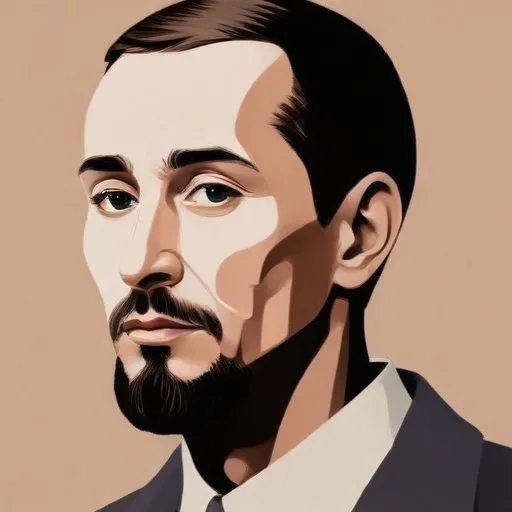
A Russian painter and academic who created influential works of art that blended traditional Russian styles with Western European techniques, and taught at the Imperial Academy of Arts.
Anton Pavlovich Losenko was a Russian neoclassical painter and academician who revolutionized the art world with his breathtaking historical subjects and portraits. As one of the founders of the Imperial Russian historical movement in painting, Losenko's works continue to inspire generations of artists and art enthusiasts alike.
Born on August 10, 1737, in Hlukhiv, Ukraine, Losenko was orphaned at a young age and sent to the Court Choir in Saint Petersburg at just seven years old. Although he lost his voice, his talent for painting was soon discovered, and he was apprenticed to the renowned artist Ivan Argunov in 1753.
After five and a half years of rigorous training, Losenko was admitted to the Imperial Academy of Arts in 1759, where he honed his skills and created some of his earliest masterpieces, including the Portrait of Ivan Shuvalov and Portrait of Alexander Sumarokov, both completed in 1760.
In 1760, the Academy sent Losenko to Paris to study art under the tutelage of the French neoclassical painter Jean II Restout. During his time in Paris, Losenko created a magnificent painting based on the New Testament story of the miraculous catch of fish, which showcased his growing talent and mastery of neoclassical techniques.
In 1766-1769, Losenko worked in Rome, immersing himself in Italian art and studying the works of Raphael. This period saw the creation of two of his most celebrated paintings, Kain and Abel, which demonstrated his ability to capture the essence of human emotion and drama.
In 1769, Losenko returned to Saint Petersburg, where he was tasked with creating a historical painting as a way of receiving Academician status in the Imperial Academy of Arts. His response was the magnificent Vladimir I of Kiev and Rogneda of Polotsk, a masterpiece that not only earned him the title of Academician but also a professorship position at the Imperial Academy.
As a professor, Losenko wrote a seminal textbook, Short Explanation of the Human Proportions, which became a seminal guide for generations of Russian painters. His influence on the art world continued to grow, and he was eventually appointed director of the Imperial Academy in 1772.
Anton Losenko's contributions to Russian art and culture are immeasurable. He played a pivotal role in shaping the country's neoclassical movement, inspiring a new generation of artists, and leaving behind a legacy of breathtaking works that continue to inspire and awe art lovers today.
Despite his many achievements, Losenko's personal life remains somewhat of an enigma. He died on December 4, 1773, at the age of 36, leaving behind a body of work that continues to inspire and captivate art lovers around the world.
In recognition of his contributions to Russian art, Losenko was posthumously awarded several honors, including the title of Academician of the Imperial Academy of Arts and a memorial plaque at the Academy.
Today, Losenko's works can be found in museums and galleries across Russia, including the State Russian Museum, the Tretyakov Gallery, and the Hermitage Museum, serving as a testament to his enduring legacy and artistic genius.
Born in 1737
A Russian painter and academic who created influential works of art that blended traditional Russian styles with Western European techniques, and taught at the Imperial Academy of Arts.
Born in 1757
A prominent Ukrainian-Russian painter of the late 18th and early 19th centuries, known for his elegant and intimate portraits of Russian aristocracy. His works are celebrated for their subtlety and emotional depth.
