


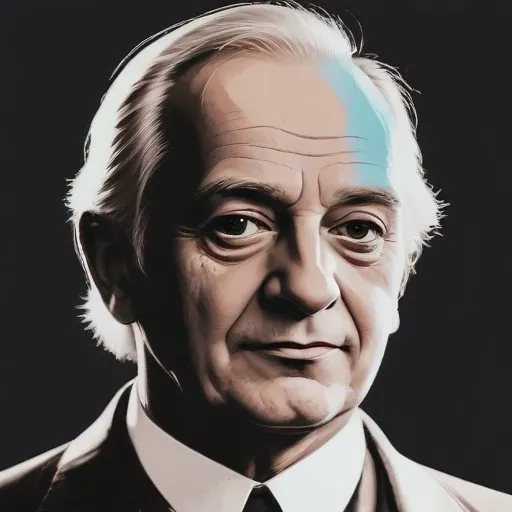
A prominent Ukrainian-Russian painter of the late 18th and early 19th centuries, known for his elegant and intimate portraits of Russian aristocracy. His works are celebrated for their subtlety and emotional depth.
Vladimir Borovikovsky is renowned for dominating the Russian art scene at the turn of the 19th century, capturing the essence of his subjects with uncanny precision and sensitivity. As a celebrated portrait painter, he created over 500 portraits during his lifetime, with nearly 400 surviving to this day.
Born on July 24, 1757, in Mirgorod, Cossack Hetmanate (now Ukraine), Borovikovsky came from a family of Ukrainian Cossack origin. His father, Luka Borovik, was an icon painter, and the family tradition dictated that all four sons serve as Cossacks. However, Vladimir retired early at the rank of poruchik to pursue his passion for art, initially focusing on icon painting for local churches.
In 1788, Borovikovsky's friend, Vasily Kapnist, requested his assistance in preparing an accommodation for Empress Catherine II in Kremenchuk. The artist's allegoric paintings, featuring Peter I and Catherine II as peasants sowing seeds, and Catherine II as Minerva, so impressed the Empress that she invited him to Saint Petersburg. This marked the beginning of Borovikovsky's illustrious career at the imperial court.
After relocating to Saint Petersburg, Borovikovsky changed his surname to the more aristocratic-sounding Borovikovsky. He spent his initial ten years in the city living in the house of Prince Nikolay Lvov, a poet, architect, musician, and art theorist. Lvov's ideas had a profound impact on Borovikovsky's art, shaping his unique style. Due to his advanced age, Borovikovsky was unable to attend the St. Petersburg Imperial Academy of Arts and instead took private lessons from Dmitry Levitzky and Johann Baptist Lampi.
In 1795, Borovikovsky was appointed an academician, solidifying his reputation as a master artist. He established his own studio, often relying on assistants to help him with his workload. Borovikovsky's portraits were highly sought after by the Russian nobility, and he went on to create some of his most iconic works during this period.
Vladimir Borovikovsky's contributions to Russian art are immeasurable. He single-handedly elevated portraiture in Russia, bringing a level of sophistication and elegance that had not been seen before. His work continues to inspire artists and art enthusiasts alike, offering a unique glimpse into the lives of 18th- and 19th-century Russian aristocracy.
Despite his professional success, Borovikovsky's personal life remains somewhat enigmatic. He married twice, first to a Ukrainian woman, and later to a Russian noblewoman. The artist died on April 6, 1825, leaving behind a legacy that continues to captivate art lovers to this day.
Vladimir Borovikovsky's remarkable life and artistic achievements have left an indelible mark on Russian art history. His portraits continue to inspire and captivate us, offering a glimpse into the lives of 18th- and 19th-century Russian society.
Born in 1737
A Russian painter and academic who created influential works of art that blended traditional Russian styles with Western European techniques, and taught at the Imperial Academy of Arts.
Born in 1799
A Russian Romantic painter who created vibrant, emotive works that captured the essence of everyday life and mythology, earning him the title "the founder of the Romantic movement in Russia".
Born in 1844
A Russian master of realism, known for vivid depictions of Russian life and history, capturing the essence of the human experience through his brushstrokes.
