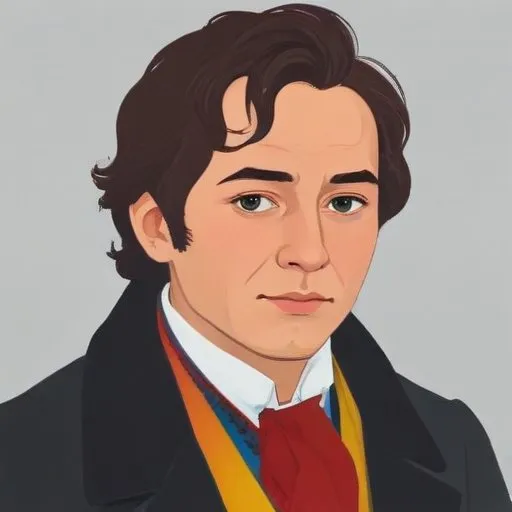
Karl Bryullov: The Russian Romanticism Mastermind
A Brush with Greatness: Karl Bryullov's Rise to Fame
Karl Bryullov, a name synonymous with Russian Romanticism, is renowned for his mesmerizing oil paintings that transported art lovers to a bygone era. His magnum opus,
The Last Day of Pompeii, a sprawling masterpiece created between 1830 and 1833, catapulted him to international acclaim, earning comparisons to the likes of Rubens and Van Dyck.
Early Life and Education
Born on December 12, 1799, in St. Petersburg, Russia, Karl Bryullov was the son of Pavel Ivanovich Briullo, an academician, woodcarver, and engraver of Huguenot descent. His early years were marked by an affinity for Italy, which would later become his adopted home. Bryullov's artistic talents were nurtured at the Imperial Academy of Arts, where he studied from 1809 to 1821. Although he was an exceptional student, he never fully subscribed to the classical style taught by his mentors, opting instead to forge his own path.
A Leap of Faith: Journey to Italy
In 1822, Bryullov bid farewell to Russia, embarking on a journey to Italy, where he would spend the next 13 years honing his craft. As a portraitist and genre painter, he earned a reputation for his captivating portraits, which were sought after by the aristocracy and intellectual elite. Italy would become his muse, inspiring some of his most iconic works.
The Last Day of Pompeii: A Masterpiece is Born
It was in Italy that Bryullov created his pièce de résistance,
The Last Day of Pompeii, a sprawling canvas that measured over 15 feet in length. This epic painting transported viewers to the ill-fated city of Pompeii on the eve of its destruction, evoking emotions and sparking the imagination. The work's sheer scale, detail, and emotional resonance cemented Bryullov's status as a master of Romanticism.
A Return to Russia and Academic Accolades
In 1835, Bryullov returned to Russia, where he was welcomed as a hero. He was appointed to a prominent position at the Imperial Academy of Arts, where he taught from 1836 to 1848. During this period, he refined his portrait style, blending neoclassical simplicity with romantic expression. His likenesses of prominent Russians, including the aristocracy and intellectuals, continue to fascinate art enthusiasts to this day.
Personal Milestones and Key Life Events
- 1835: Bryullov returns to Russia, where he is hailed as a national hero.
- 1836-1848: He teaches at the Imperial Academy of Arts, refining his portrait style.
- 1848: Bryullov's health begins to decline, forcing him to curtail his artistic pursuits.
- June 11, 1852: Karl Bryullov passes away, leaving behind a legacy that continues to inspire.
Legacy and Impact on Modern Society
Karl Bryullov's artistic contributions extend far beyond his own lifetime. He is credited with paving the way for Russian Romanticism, influencing generations of artists to come. His masterpieces continue to captivate audiences, transporting them to a bygone era. In the words of
Leo Tolstoy, "Bryullov's painting was a revelation, a disclosure of a new world, a new beauty, a new joy."
FAQ
What was Karl Bryullovs most famous painting?
Karl Bryullov was a Russian painter who created many famous works, but his most famous painting is probably The Last Day of Pompeii, which depicts the eruption of Mount Vesuvius and the destruction of the ancient city of Pompeii.
How did Karl Bryullovs travel to Italy influence his art?
Karl Bryullovs travel to Italy had a significant impact on his art, as he was exposed to the works of the Old Masters and the classical traditions of Italian art. He was influenced by the grandeur and beauty of Italian art, which is reflected in his own paintings.
What was Karl Bryullovs role in the development of Russian art?
Karl Bryullov was a prominent Russian painter who played a significant role in the development of Russian art. He was one of the first Russian artists to achieve international recognition, and his work paved the way for future generations of Russian artists.
How did Karl Bryullovs portraits reflect his subjects personalities?
Karl Bryullovs portraits are known for their psychological insight and ability to capture the personalities of his subjects. He was able to convey the subtleties of human emotion and character through his use of color, light, and composition.
What is Karl Bryullovs legacy in the world of art?
Karl Bryullovs legacy in the world of art is that of a brilliant painter who was able to capture the beauty and drama of the human experience. He is remembered as one of the greatest Russian painters of all time, and his works continue to inspire and influence artists to this day.