


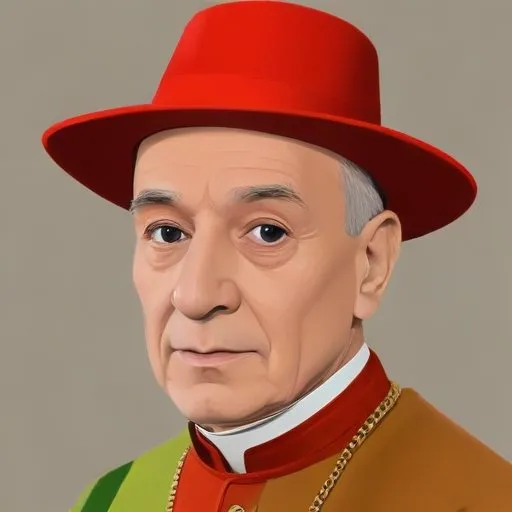
A 15th-century Italian cardinal who played a key role in the Council of Basel and was a prominent figure in the Roman Catholic Church during the Renaissance. He's known for his diplomatic efforts to reunite the Eastern and Western churches.
Antonio Correr, a renowned Roman Catholic Cardinal, is best known for his significant contributions to the Church during the tumultuous period of the Great Western Schism. Born in Venice in 1359, Correr's life was marked by his unwavering dedication to his faith and his influential role in shaping the Church's trajectory.
Correr was born into a family of clerics, with his uncle, Pope Gregory XII, playing a pivotal role in his early life and career. His father, Filippo Correr, and mother, Cassandra Venier, instilled in him a strong sense of spirituality and moral values. Correr's cousin, Pope Eugene IV, would later become a prominent figure in his life, further solidifying his connections within the Church.
Correr's climb to prominence began when his uncle, Pope Gregory XII, appointed him as a Cardinal in 1407. This appointment not only signaled Correr's rise to power but also marked the beginning of his involvement in the complex web of Church politics. He went on to hold various positions, including Bishop of Modon, Bishop of Bologna, and Cardinal Priest of San Pietro in Vincoli, further cementing his authority within the Church.
During the Great Western Schism, Correr played a crucial role as a representative of the Roman Obedience of the Sacred College. He attended the Council of Constance, where he participated in the Papal conclave of 1417 and 1431. His diplomatic skills and unwavering loyalty to the Church earned him recognition as a key figure in resolving the schism.
Correr's administrative prowess was evident in his roles as Camerlengo of the Holy Roman Church (1407-1415) and Archpriest of the patriarchal Vatican Basilica (1414-1434). He also served as papal legate in Perugia (1425) and Tuscany (1431), demonstrating his ability to navigate complex ecclesiastical politics.
One of Correr's most enduring legacies is the founding of the Congregation of the Canons Regular of San Giorgio in Alga, a testament to his commitment to monastic reform. This congregation, established in his native city of Venice, would go on to become a beacon of spirituality and learning.
Correr's life was marked by significant personal milestones, including his consecration as bishop by Pope Gregory XII in 1407. His relationships with prominent figures, such as Cardinal Baldassare Cossa, highlighted the intricate web of alliances and rivalries that shaped Church politics during this tumultuous period.
Antonio Correr's life was a testament to his unwavering dedication to the Roman Catholic Church. Through his numerous roles and achievements, he left an indelible mark on the Church's history, cementing his place as one of the most influential Cardinals of his time.
Born in 1535
The second shortest-reigning pope in history, serving for just 27 days in 1605, he is most known for his brief but tumultuous papacy marked by power struggles and controversy.
Born in 1536
Led the Catholic Church during a tumultuous period, issuing papal bulls and playing a key role in the Counter-Reformation. He's also famous for his coffee habit, being the first Pope to try and approve of it.
Born in 1487
A 16th-century Pope who commissioned Michelangelo to paint the Sistine Chapel's frescoes and was a patron of the arts, leaving a lasting impact on Renaissance art and architecture.
Born in 1417
A 15th-century pope who played a significant role in the fall of the Western Schism, ending the division in the Catholic Church. He's also known for his lavish spending and nepotism.
Born in 1504
Leader of the Catholic Church during the Counter-Reformation, he excommunicated Queen Elizabeth I and played a key role in the Council of Trent.
Born in 1502
Introduced the Gregorian calendar, a solar-based calendar that's widely used today, reforming the Julian calendar's inaccuracies.
Born in 1568
The 17th-century Catholic leader who reigned for 21 years, known for his strong stance against Galileo Galilei and his scientific discoveries, as well as his extensive patronage of the arts.
Born in 1611
Led the Catholic Church during a tumultuous period, reforming the Church's finances and combating corruption, while also opposing the French monarch's attempts to exert control over the Church.
