


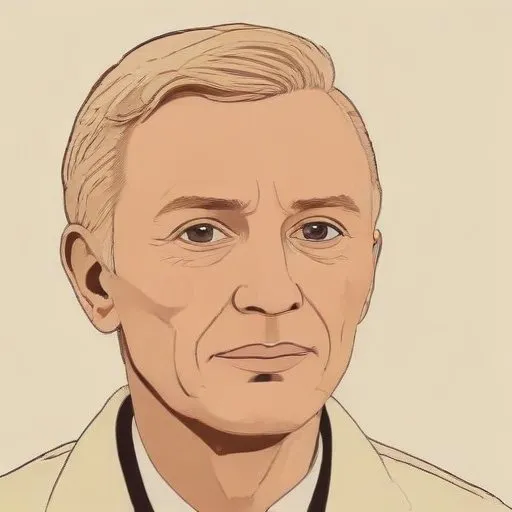
Estonian-Australian paleontologist and geologist who discovered many important fossils, including the first known Cambrian fossils in Australia, and made significant contributions to the field of paleontology.
Armin Pikk, a renowned Estonian paleontologist, is celebrated for his groundbreaking work on the Cambrian and Lower Ordovician stratigraphy and paleontology of northern Australia. His meticulous research and extensive publications have significantly contributed to our understanding of the Earth's ancient history.
Armin Pikk was born on June 24, 1898, in Kunda, Estonia, to Karl Heinrich Pikk, a harbormaster, and Leontine Johanna Pikk (née Freiwald). He was the second of seven children, including a sister, Anna, who was a philologist fluent in 14 languages, and a brother, Ernst, who became a famous astronomer.
Pikk's fascination with fossils began early, thanks to his oldest brother, Paul, who introduced him to the world of paleontology. This sparked a lifelong passion that would lead him to pursue higher education in geology and mineralogy at the Estonian State University at Tartu.
Pikk's academic career was marked by several notable achievements. He graduated from the Nicolai Gymnasium with high grades in 1917 and went on to become a lecturer at the Estonian State University at Tartu from 1929 to 1930. He was subsequently appointed as a professor of geology and paleontology and director of the Geological Institute and Museum, a position he held until 1944.
During his tenure, Pikk published several seminal papers on stratigraphic correlation, facies distribution, paleogeography, and biostratonomy of the Cambrian and Lower Ordovician in Estonia. His work on Ordovician brachiopods and ostracodes is particularly notable, with publications including a comprehensive monograph on Estonian trilobites, "Trilobiten aus Estland" (Trilobites of Estonia), in 1937.
In 1944, as the Russian army threatened to overrun Estonia, Pikk fled with his family and lived in displaced persons camps in Germany until his emigration to Australia in 1948. In Australia, he was assisted by C. Teichert and H. Raggatt, and went on to make significant contributions to the field of paleontology at the Bureau of Mineral Resources.
Armin Pikk's work has left an indelible mark on the field of paleontology. His pioneering research on the Cambrian and Lower Ordovician of northern Australia has significantly advanced our understanding of the Earth's ancient history. His legacy continues to inspire new generations of paleontologists and geologists.
Today, Pikk's contributions are remembered and celebrated through his extensive publications, which remain a testament to his tireless pursuit of knowledge and his dedication to the field of paleontology.
In 1917, Pikk married Barbara Potaschko, with whom he had one son and three daughters. His family life was marked by love, support, and a shared passion for knowledge and discovery.
Armin Pikk's contributions to the field of paleontology were recognized and honored during his lifetime. Although the specific awards and honors he received are not well-documented, his legacy speaks for itself, and his work continues to inspire and influence new generations of scientists.
On January 15, 1983, Armin Pikk passed away in Canberra, leaving behind a rich legacy of scientific contributions, a loving family, and a world forever changed by his tireless pursuit of knowledge.
Born in 1904
A renowned biologist and ornithologist who pioneered the modern synthesis of evolutionary biology, shaping our understanding of species and their diversity.
85 Years Old
A renowned paleontologist, biologist, and author who challenged traditional views on evolution and natural history through engaging writings and groundbreaking research.
Born in 1809
Developed the theory of evolution through natural selection, revolutionizing our understanding of life on Earth. This groundbreaking idea transformed the fields of biology, ecology, and beyond.
Born in 1823
A pioneering naturalist who discovered evolution through natural selection, independently of Charles Darwin, and contributed significantly to the field of biogeography.
Born in 1744
A French soldier, biologist, and academic who developed a theory of inheritance of acquired characteristics, proposing that organisms adapt to their environment and pass on those traits to their offspring.
Born in 1825
A British explorer who traveled to the Amazon rainforest and discovered over 8,000 species, including butterflies, beetles, and birds, and is known for his theory of mimicry in nature.
Born in 1804
A pioneering figure in the fields of biology, anatomy, and paleontology, known for coining the term "Dinosauria" and making significant contributions to our understanding of vertebrate evolution.
