


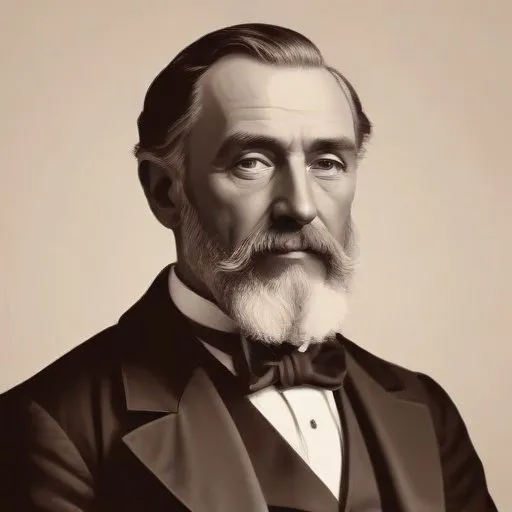
A British explorer who traveled to the Amazon rainforest and discovered over 8,000 species, including butterflies, beetles, and birds, and is known for his theory of mimicry in nature.
Henry Walter Bates, a trailblazing naturalist, is renowned for his groundbreaking discovery of mimicry in animals, shedding light on the fascinating world of camouflage and deception in the natural kingdom. This English explorer's remarkable findings on the Amazon rainforest expedition with Alfred Russel Wallace in the mid-19th century left an indelible mark on the scientific community.
Born on February 8, 1825, in Leicester, England, Bates hailed from a literate middle-class family. His curiosity-driven nature led him to pursue an education in his spare time, despite being apprenticed to a hosiery manufacturer at the age of 13. This commitment to self-learning earned him a spot at the Mechanics Institute, where he devoured books on entomology and geology.
Bates' interests in insects and botany were sparked by his friendship with Alfred Russel Wallace, with whom he shared a passion for exploring the Amazon rainforest. This unlikely duo drew inspiration from influential works by Thomas Robert Malthus, James Hutton, and Charles Lyell, among others.
In 1848, Bates and Wallace embarked on an epic 11-year expedition to the Amazon rainforest, a journey that would change the course of their lives and the scientific community. While Wallace returned in 1852, Bates remained in the Amazon, meticulously collecting and documenting over 14,712 species, including 8,000 new to science.
This remarkable feat was no easy task, as Bates faced numerous challenges, from navigating treacherous terrain to coping with the harsh conditions of the rainforest. His dedication to his work, however, paid off, resulting in the publication of his seminal work, The Naturalist on the River Amazons.
Bates' pioneering work on mimicry has had a profound impact on our understanding of evolutionary biology. His observations of animals' remarkable ability to adapt and blend into their environment have inspired generations of scientists and naturalists.
Today, Bates' legacy extends beyond his groundbreaking research. His work has inspired a new wave of explorers, scientists, and conservationists, who continue to uncover the secrets of the natural world and fight to protect our planet's precious ecosystems.
Henry Walter Bates' remarkable journey has left an indelible mark on the world of science and beyond. His courage, curiosity, and dedication to discovery continue to inspire us all to explore, protect, and cherish the natural world.
Born in 1823
A pioneering naturalist who discovered evolution through natural selection, independently of Charles Darwin, and contributed significantly to the field of biogeography.
Born in 1809
Developed the theory of evolution through natural selection, revolutionizing our understanding of life on Earth. This groundbreaking idea transformed the fields of biology, ecology, and beyond.
Born in 1840
A renowned mountaineer, explorer, and author, known for being the first person to ascend the Matterhorn, a feat that cost him four lives, and for his detailed illustrations of the Alps.
66 Years Old
A British entrepreneur and Liberal Democrat politician who served as a Member of Parliament and was involved in various business ventures, including a music company and a chain of bars.
Born in 1821
A 19th-century explorer who ventured into uncharted territories, mapping Africa's Nile River and uncovering hidden cities, earning a reputation as a daring adventurer and scholar.
