


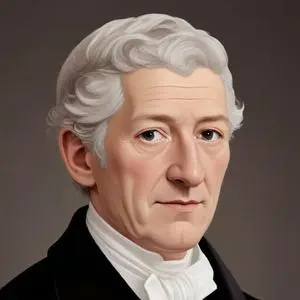
Predicted a population growth crisis due to food supply limitations, sparking debate on resource management and sustainability. Known for his influential work on demographics and economics.
Thomas Robert Malthus, a renowned English economist, cleric, and scholar, is best known for his groundbreaking work on population growth and its impact on the economy, An Essay on the Principle of Population, published in 1798. In this seminal work, Malthus proposed the concept of the "Malthusian trap" or "Malthusian spectre," which suggests that population growth is limited by the availability of resources, leading to a perpetual cycle of poverty and hardship.
Born on February 13, 1766, in Surrey, England, Malthus was the sixth of seven children to Daniel and Henrietta Malthus. He was educated at Jesus College, Cambridge, where he developed a passion for mathematics and economics. Malthus was ordained as an Anglican cleric in 1791 and went on to serve as a curate in Surrey.
Malthus' views on population growth were deeply rooted in his philosophical beliefs about human nature and the economy. He believed that humans had a tendency to use abundance for population growth rather than maintaining a high standard of living, leading to a Malthusian catastrophe. This pessimistic view was often criticized by his contemporaries, who saw society as improving and perfectible.
Malthus proposed that population growth would inevitably outstrip food production, leading to widespread poverty, want, and susceptibility to war, famine, and disease. He argued that the power of population is indefinitely greater than the power in the earth to produce subsistence for man. This concept has had a lasting impact on the fields of economics, demography, and political science.
Malthus was a prominent figure in the British East India Company and served as a professor of history and political economy at the East India Company College from 1805 to 1834.
Malthus' ideas have had a profound impact on modern society, influencing pioneers of evolutionary biology such as Charles Darwin and Alfred Russel Wallace. His work has also shaped economic and political thought, with many regarding him as the precursor to modern demography.
Malthus' views on population growth and the Poor Laws were often criticized and controversial in his lifetime. His support for taxes on grain imports and opposition to the Poor Laws led to public debate and scrutiny.
"The power of population is indefinitely greater than the power in the earth to produce subsistence for man."
Malthus' legacy continues to shape our understanding of population growth, economics, and demography, making him one of the most influential thinkers of the 19th century.
61 Years Old
A lawyer and politician who served in the U.S. House of Representatives from 1987 to 1997, known for his moderate Republican views and advocacy for environmental issues.
Born in 1772
A British economist and politician who developed the concept of comparative advantage, which revolutionized international trade and shaped modern economic theory.
Born in 1806
A prominent 19th-century thinker who championed individual liberty, free speech, and women's rights, and is best known for his influential book "On Liberty".
Born in 1818
A 19th-century philosopher who developed the theory of communism, arguing that capitalism would eventually be replaced by a socialist society. He's known for his critique of capitalism and the concept of class struggle.
Born in 1883
A pioneering economist who revolutionized modern economic theory with his groundbreaking ideas on government intervention and fiscal policy, shaping global economic policies.
Born in 1899
Austrian economist and philosopher who championed free market capitalism and limited government intervention, warning of the dangers of socialism and totalitarianism. His work influenced economic policy and shaped modern libertarian thought.
Born in 1912
A Nobel Prize-winning economist who championed free market capitalism and limited government intervention, known for his advocacy of laissez-faire economics and influential writings on monetary policy.
Born in 1915
A renowned economist and academic who made significant contributions to the field of economics, particularly in the areas of macroeconomics and international trade. He was awarded the Nobel Prize in Economics in 1970.
