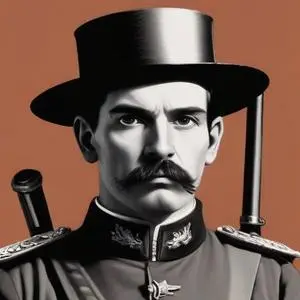
Sir Richard Francis Burton: Explorer, Scholar, and Polymath
A Life of Adventure and Discovery
Sir Richard Francis Burton is best known for his daring expeditions and groundbreaking discoveries in uncharted territories, earning him the reputation as one of the most formidable explorers of the 19th century. His remarkable journey to Mecca in disguise, as a non-Muslim, is a testament to his bravery and cunning, as it was a feat punishable by death during that time.
A Linguistic Genius
Burton's extraordinary gift for languages allowed him to converse in 29 tongues, a feat that facilitated his extensive travels and cultural immersion. This remarkable talent enabled him to translate and interpret ancient texts, including the infamous
One Thousand and One Nights, also known as
The Arabian Nights, which he rendered into English from
Antoine Galland's French version.
Unveiling the Secrets of the East
Burton's translation of the
Kama Sutra, an ancient Indian Hindu text, and
The Perfumed Garden, the Arab Kama Sutra, offered the Western world a glimpse into the mysteries of Eastern sexuality and eroticism. His works not only fascinated but also challenged the conventional Victorian morality of the time.
African Odyssey
Burton's expedition to the Great Lakes of Africa with
John Hanning Speke marked a significant milestone in the history of exploration. The duo braved treacherous terrain and hostile tribes to become the first Europeans to reach the source of the Nile, a feat that sparked international attention and debate.
A Critic of Colonialism
Despite being a product of the British Empire, Burton's works and letters vociferously criticized colonial policies, often to the detriment of his own career. His experiences in India and Africa led him to question the exploitative nature of colonialism, and he advocated for a more empathetic understanding of indigenous cultures.
Erudite Author and Scholar
Burton's literary output was staggering, with numerous books and articles on subjects ranging from human behavior, travel, falconry, fencing, and ethnography. His characteristic copious footnotes and appendices, containing remarkable observations and information, demonstrated his painstaking research and attention to detail.
Personal Milestones and Key Life Events
- Born on March 19, 1821, in Torquay, Devon, England
- Studies at Trinity College, Oxford, although he did not complete his degree
- Serves as a captain in the army of the East India Company in India
- Travels to Mecca in disguise (1853)
- Explores the Great Lakes of Africa with John Hanning Speke (1857-1859)
- Marries Isabel Arundell in 1861
- Dies on October 20, 1890, in Trieste, Austria-Hungary
Legacy and Historical Context
Burton's extraordinary life and accomplishments have inspired generations of explorers, writers, and scholars. His contributions to the fields of anthropology, linguistics, and literature are immeasurable, and his critiques of colonialism remain relevant today. As a testament to his impact, Burton's works continue to fascinate readers, offering a unique window into the cultures and societies he encountered during his incredible journeys.
Quotes and Memorable Sayings
- "Do what thy manhood bids thee do, from none but self expect applause."
- "The more I study religions, the more I am convinced that man never worshipped anything but himself."
Trivia and Fun Facts
- Burton was a skilled swordsman and adept in various martial arts.
- He was known for his exceptional physical strength and endurance.
- Burton was a prolific writer, penning over 40 books and countless articles.
Influence on Modern Society
Burton's writings and discoveries have had a lasting impact on modern society, influencing literature, film, and popular culture. His expeditions and writings have inspired countless adventurers, authors, and scholars, ensuring that his legacy continues to inspire and captivate audiences worldwide.
FAQ
What are Richard Francis Burtons most famous expeditions?
Burton is famous for his expeditions to Mecca, his search for the source of the Nile River, and his travels to West Africa. He was a prolific explorer and adventurer.
What was Richard Francis Burtons role in the discovery of Lake Tanganyika?
Burton, along with John Speke, discovered Lake Tanganyika in 1858. This discovery was a significant milestone in the exploration of Africa.
What was Richard Francis Burtons contribution to linguistics?
Burton was a skilled linguist and translated many works from several languages, including Arabic and Portuguese. He was particularly interested in the languages of Africa and Asia.
What was Richard Francis Burtons relationship with Isabel Arundell?
Burton married Isabel Arundell in 1861, and she became his companion and supporter throughout his life. She was also his biographer.
When did Richard Francis Burton live?
Richard Francis Burton lived from 1821 to 1890, a period of significant colonial expansion and exploration in Africa and Asia.