


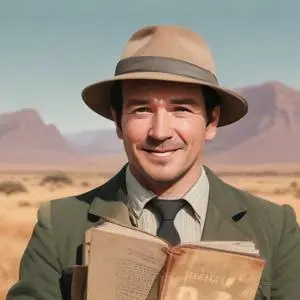
A Scottish missionary and explorer who traversed Africa, mapping its rivers and discovering Victoria Falls, while fighting against the slave trade. He embodied courage, compassion, and curiosity.
David Livingstone was a Scottish physician, Congregationalist, and pioneer Christian missionary who embarked on a perilous journey to explore Africa, driven by his obsession to uncover the sources of the Nile River and abolish the East African Arab-Swahili slave trade.
As an iconic figure of the late 19th-century Victorian era, Livingstone's name became synonymous with bravery, selflessness, and unwavering dedication to his causes, earning him a mythic status that transcended borders and generations.
Born on March 19, 1813, in Blantyre, Scotland, Livingstone was the second of seven children to Neil Livingstone and Agnes Hunter. Growing up in a humble mill town on the banks of the River Clyde, Livingstone's early life was marked by hard work and a strong sense of duty, instilled in him by his parents.
In 1836, Livingstone enrolled in the University of Glasgow, where he studied theology and medicine. It was during this period that he became acquainted with the London Missionary Society, which would shape his future and propel him towards Africa.
In 1840, Livingstone was ordained as a minister and subsequently joined the London Missionary Society, marking the beginning of his missionary journey to Africa.
Livingstone's African odyssey took him to the southern regions of the continent, where he witnessed firsthand the atrocities of the slave trade. He became determined to expose the horrors of slavery and advocate for its abolition.
Between 1849 and 1851, Livingstone embarked on an arduous journey to explore the Zambezi River, which he believed could be a viable route for Christian missionaries and traders, thereby counteracting the slave trade.
In 1845, Livingstone married Mary Moffat, a member of a prominent missionary family, with whom he had four children.
In 1865, Livingstone's health began to deteriorate, and he returned to England, where he was hailed as a hero and a national icon.
David Livingstone's legacy extends far beyond his remarkable expeditions and discoveries. He inspired a generation of explorers, missionaries, and abolitionists, who continued his work long after his passing.
In 1873, Livingstone's death in Africa sparked a wave of national mourning, and he was buried in Westminster Abbey, a testament to his enduring impact on British society.
"I am immortal till my work is done."
"I am prepared to go anywhere, provided it be forward."
Livingstone's crusade against slavery and his advocacy for African exploration and development continue to inspire humanitarian efforts and global initiatives today.
In recognition of his remarkable contributions, Livingstone's legacy has been honored with numerous tributes, including the David Livingstone Centre in Blantyre, Scotland, and the Livingstone Museum in Zambia.
Born in 1904
A Broadway performer and recording artist, known for his smooth baritone voice and starring roles in musicals like "The Love Song" and "Hedda Gabler".
