


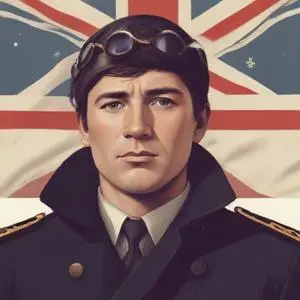
Led a British expedition to the South Pole, racing against a Norwegian team, and tragically perished on the return journey. He is remembered for his bravery and sacrifice in the pursuit of scientific discovery.
Robert Falcon Scott, a British Royal Navy officer and explorer, is best known for leading two expeditions to the Antarctic regions, including the Terra Nova expedition of 1910-1913, which reached the South Pole on January 17, 1912, just weeks after Amundsen's South Pole expedition. Scott's bravery, determination, and tragic fate have made him an iconic figure in the history of exploration.
Scott was born on June 6, 1868, in Plymouth, Devon, England. He joined the Royal Navy at the age of 13 and served in various capacities, including as a torpedo lieutenant. In 1899, he met Sir Clements Markham, the president of the Royal Geographical Society, which sparked his interest in Antarctic exploration.
Scott led his first Antarctic expedition, the Discovery expedition, which aimed to explore the Antarctic coast and conduct scientific experiments. During this expedition, Scott set a new southern record by marching to latitude 82°S and discovered the Antarctic Plateau, where the South Pole is located.
The Terra Nova expedition was Scott's second and final Antarctic expedition. He led a party of five, including himself, to the South Pole, which they reached on January 17, 1912. However, they were unaware that Amundsen's South Pole expedition had reached the pole just weeks earlier.
Scott and his party faced extreme weather conditions, and their planned meeting with supporting dog teams from the base camp failed. They perished on the return journey, with their bodies discovered on November 12, 1912. The expedition's discovery of Antarctic fossils, including those from the Glossopteris tree, provided significant scientific insights.
Following Scott's death, he was hailed as a national hero, with memorials erected across the UK. However, in the latter half of the 20th century, questions were raised about his competence and character. More recent assessments have reevaluated Scott's accomplishments and acknowledged the extreme challenges he faced during the Terra Nova expedition.
Scott's expeditions contributed significantly to the understanding of Antarctica's geography, climate, and natural resources. He believed in the importance of scientific exploration and was dedicated to advancing human knowledge.
Scott's expeditions have had a lasting impact on our understanding of Antarctica and the Antarctic region. His discoveries have contributed to the development of scientific research, tourism, and conservation efforts in the region.
"I do not think we can hope for any better things now. We shall stick it out to the end, but we are getting weaker, of course, and the end cannot be far."
- Robert Falcon Scott, Last Entry in his Diary, March 29, 1912
Scott's expeditions took place during the Heroic Age of Antarctic Exploration, a period of intense exploration and discovery in Antarctica. His legacy continues to inspire scientific research, exploration, and conservation efforts in the region.
Scott was posthumously awarded the Polar Medal and the Royal Geographical Society's Founder's Medal. He was also honored with a memorial in St. Paul's Cathedral, London.
Scott's expeditions contributed to the advancement of scientific knowledge and exploration. His legacy continues to inspire charitable and social contributions to the field of Antarctic exploration and conservation.
Born in 1872
First person to reach the South Pole, leading a Norwegian expedition in 1911, and a pioneer in Arctic and Antarctic exploration.
Born in 1874
Led expeditions to the Antarctic, famously surviving a disastrous shipwreck and trekking to safety, earning a legendary reputation for bravery and leadership.
Born in 1856
Led the first expedition to reach the North Pole, claiming its discovery in 1909. He's remembered for his bravery and perseverance in the face of extreme Arctic conditions.
41 Years Old
A Welsh rugby union player who captained Wales and the British and Irish Lions, known for his exceptional skill and leadership on the pitch.
Born in 1813
A Scottish missionary and explorer who traversed Africa, mapping its rivers and discovering Victoria Falls, while fighting against the slave trade. He embodied courage, compassion, and curiosity.
