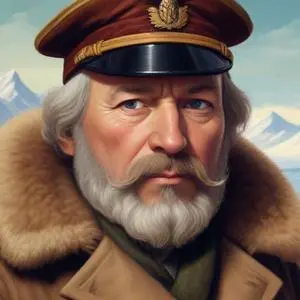
Robert Peary: The Fearless Arctic Explorer
The First to Reach the North Pole?
Robert Peary, an American explorer and officer in the United States Navy, made history by becoming the first person to claim to have reached the geographic North Pole in April 1909. Although it is now disputed whether he actually reached the exact pole, Peary's expeditions to the Arctic in the late 19th and early 20th centuries paved the way for future explorers.
Early Life and Career
Born on May 6, 1856, in Cresson, Pennsylvania, Peary's early life was marked by tragedy when his father passed away. He was raised in Cape Elizabeth, Maine, and went on to attend Bowdoin College. After completing his education, Peary joined the United States Coast and Geodetic Survey as a draftsman. In 1881, he enlisted in the navy as a civil engineer, which laid the foundation for his future expeditions.
The Arctic Expeditions
Peary's first Arctic expedition took place in 1886, where he attempted to cross Greenland by dogsled. Although the attempt was unsuccessful, Peary didn't give up. In 1891, he led an expedition to Greenland, where he reached Independence Fjord and proved that Greenland was an island. This achievement cemented his reputation as a skilled explorer.
Studying the Inuit
During his expeditions, Peary was one of the first Arctic explorers to study the Inuit survival techniques. He learned from them and adapted their methods to survive in the harsh Arctic environment. Although he was criticized for his treatment of the Inuit people, Peary's knowledge of their techniques helped him to survive in the Arctic.
The Controversies
Peary's expeditions were not without controversy. During his 1894 expedition, he deceived six Inuit individuals into traveling to America with him, promising them tools, weapons, and gifts. Unfortunately, four of the six Inuit died of illnesses within a few months. This incident tarnished Peary's reputation and raised questions about his treatment of indigenous people.
Legacy and Impact
Despite the controversies, Peary's expeditions paved the way for future explorers and scientists. His discovery of the North Pole, although disputed, marked a significant milestone in the history of exploration. Peary's legacy extends beyond his expeditions; he also contributed to the development of navigation and cartography.
Awards and Honors
Peary received numerous awards and honors for his expeditions, including the Hubbard Medal from the National Geographic Society. He was also promoted to rear admiral in the United States Navy.
Personal Life
Peary was married to Josephine Diebitsch Peary, and they had two children together. He passed away on February 20, 1920, leaving behind a legacy of exploration and discovery.
Fun Facts
- Peary's expedition to the North Pole was sponsored by the National Geographic Society.
- He was the first person to set foot on the northernmost point of Greenland, Cape Morris Jesup.
- Peary's expeditions were often marked by tragedy, including the loss of several team members and the death of his own son.
Conclusion
Robert Peary's legacy is a testament to the power of human exploration and discovery. Although his expeditions were not without controversy, Peary's contributions to the field of exploration and his determination to reach the North Pole have inspired generations of explorers and scientists.
FAQ
What was Robert Pearys contribution to Arctic exploration?
Robert Peary was an American admiral and explorer who made several expeditions to the Arctic region, culminating in his successful journey to the North Pole in 1909.
What was Robert Pearys approach to Arctic exploration?
Robert Pearys approach to Arctic exploration was characterized by his emphasis on meticulous planning, careful preparation, and innovative techniques, such as the use of sled dogs and advanced clothing.
What were some notable expeditions led by Robert Peary?
Robert Peary led several notable expeditions, including the 1893-1894 expedition to Greenland, the 1898-1902 expedition to the Arctic, and the 1908-1909 expedition to the North Pole.
What challenges did Robert Peary face during his Arctic expeditions?
Robert Peary faced numerous challenges during his Arctic expeditions, including harsh weather conditions, treacherous terrain, and the risk of scurvy and other diseases.
What legacy did Robert Peary leave behind in Arctic exploration?
Robert Pearys legacy in Arctic exploration is that of a pioneering explorer who pushed the boundaries of human endurance, expanded our knowledge of the Arctic region, and inspired future generations of explorers and scientists.