


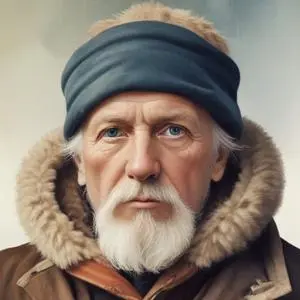
A Norwegian pioneer who explored the Arctic, made groundbreaking scientific discoveries, and championed humanitarian causes, earning a Nobel Prize for his efforts. He's most famous for being the first to cross Greenland and his innovative sled designs.
Fridtjof Nansen was a Norwegian explorer, scientist, diplomat, and humanitarian who made a lasting impact on the world. He is perhaps best known for leading the first team to cross the Greenland interior in 1888 and reaching a record northern latitude of 86°14′ during his Fram expedition of 1893-1896.
Born on October 10, 1861, in Christiania (now Oslo), Norway, Nansen was the second of three sons to Baldur and Adelaide Nansen. He developed a passion for skiing and the outdoors from an early age, which would later serve him well in his expeditions. Nansen studied zoology at the Royal Frederick University in Christiania and later worked as a curator at the University Museum of Bergen.
Nansen's research on the central nervous system of lower marine creatures earned him a doctorate and helped establish the neuron doctrine. His work in this field was pioneering, and his research laid the foundation for future scientists, including Santiago Ramón y Cajal, who won the 1906 Nobel Prize in Medicine for his research on the same subject.
In the late 1890s, Nansen's scientific interest shifted to oceanography. He made many scientific cruises, mainly in the North Atlantic, and contributed to the development of modern oceanographic equipment. His work in this field helped to advance our understanding of the ocean and its role in shaping our climate.
Nansen's explorer spirit led him to undertake some of the most daring expeditions of his time. In 1888, he led the first team to cross the Greenland interior, traversing the island on cross-country skis. This feat marked a significant milestone in the history of Arctic exploration.
The Fram expedition of 1893-1896 was another notable achievement, during which Nansen reached a record northern latitude of 86°14′. Although he retired from exploration after his return to Norway, his techniques of polar travel and innovations in equipment and clothing influenced a generation of subsequent Arctic and Antarctic expeditions.
In the early 1900s, Nansen turned his attention to diplomacy and humanitarian work. He was instrumental in persuading Prince Carl of Denmark to accept the throne of the newly independent Norway in 1905. Between 1906 and 1908, he served as the Norwegian representative in London, where he helped negotiate the Integrity Treaty that guaranteed Norway's independent status.
In the final decade of his life, Nansen devoted himself to the League of Nations, following his appointment in 1921 as the League's High Commissioner for Refugees. He worked tirelessly to assist refugees and displaced persons, earning him the Nobel Peace Prize in 1922.
Fridtjof Nansen's legacy extends far beyond his impressive list of achievements. He was a true polymath, whose work spanned multiple fields and disciplines. His contributions to science, exploration, diplomacy, and humanitarian work have inspired generations of individuals around the world.
Nansen's life was a testament to the power of human curiosity, determination, and compassion. He will always be remembered as a trailblazer who pushed the boundaries of human knowledge and understanding.
Fridtjof Nansen passed away on May 13, 1930, but his legacy continues to inspire and motivate people around the world. His remarkable life serves as a testament to the power of human achievement and the importance of pursuing one's passions, no matter how difficult or impossible they may seem.
Born in 1872
First person to reach the South Pole, leading a Norwegian expedition in 1911, and a pioneer in Arctic and Antarctic exploration.
Born in 1868
Led a British expedition to the South Pole, racing against a Norwegian team, and tragically perished on the return journey. He is remembered for his bravery and sacrifice in the pursuit of scientific discovery.
Born in 1874
Led expeditions to the Antarctic, famously surviving a disastrous shipwreck and trekking to safety, earning a legendary reputation for bravery and leadership.
Born in 1914
A pioneering explorer who sailed ancient-style boats across oceans to prove migration theories, and led the famous Kon-Tiki expedition across the Pacific.
Born in 1910
A pioneering oceanographer who co-developed the aqua-lung, allowing humans to explore the underwater world, and documented his discoveries through captivating films and books.
