


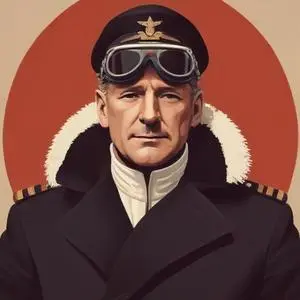
Led the first flights over the North and South Poles, and explored Antarctica, expanding our knowledge of the world's most remote regions.
Richard Evelyn Byrd Jr. is best known for being the first person to fly over the North and South Poles, a remarkable feat that cemented his place in the annals of aviation history. As a pioneering American aviator, polar explorer, and organizer of polar logistics, Byrd's expeditions and discoveries left an indelible mark on the world of exploration and beyond.
Byrd was born on October 25, 1888, in Winchester, Virginia, to Esther Bolling Flood and Richard Evelyn Byrd Sr. He came from a long line of distinguished Virginians, including planter John Rolfe and his wife Pocahontas, William Byrd II of Westover Plantation, and colonial governor Robert King Carter. His brother, Harry F. Byrd, would later become a dominant figure in Virginia politics.
Byrd graduated from the United States Naval Academy in 1912 and served in the U.S. Navy during World War I. In 1918, he learned to fly and soon became a skilled aviator. His aerial exploits included being the first to fly across the Atlantic Ocean, a segment of the Arctic Ocean, and a segment of the Antarctic Plateau. Byrd's most notable achievement was flying over the North and South Poles, a feat he accomplished in 1926 and 1929, respectively.
However, Byrd's accomplishments were not without controversy. There is some debate as to whether he actually reached the North Pole by air, with some arguing that the distance he claimed to fly was longer than the possible fuel range of his airplane. Despite this, Byrd's contributions to aviation and exploration remain unparalleled.
Byrd's exploits earned him numerous awards and honors, including the Medal of Honor, the United States Armed Forces' highest military decoration, and the Navy Cross, the second-highest honor for valor given by the U.S. Navy. He also received the Distinguished Service Medal, the Legion of Merit, and the Antarctic Expedition Medal, among others.
Byrd married Marie Donaldson Ames in 1915, and they had four children together. He named a region of Antarctic land he discovered Marie Byrd Land after his wife, and a mountain range, the Ames Range, after her father. Byrd passed away on March 11, 1957, leaving behind a legacy that continues to inspire generations of explorers, aviators, and scientists.
Born in 1872
First person to reach the South Pole, leading a Norwegian expedition in 1911, and a pioneer in Arctic and Antarctic exploration.
Born in 1868
Led a British expedition to the South Pole, racing against a Norwegian team, and tragically perished on the return journey. He is remembered for his bravery and sacrifice in the pursuit of scientific discovery.
Born in 1874
Led expeditions to the Antarctic, famously surviving a disastrous shipwreck and trekking to safety, earning a legendary reputation for bravery and leadership.
Born in 1861
A Norwegian pioneer who explored the Arctic, made groundbreaking scientific discoveries, and championed humanitarian causes, earning a Nobel Prize for his efforts. He's most famous for being the first to cross Greenland and his innovative sled designs.
Born in 1902
The first person to fly solo non-stop across the Atlantic Ocean, completing a historic 33.5-hour flight in 1927 and becoming an international hero and aviation icon.
Born in 1897
Pioneering female aviator who broke records and pushed boundaries in flight, mysteriously disappearing during a attempted circumnavigation of the globe.
Born in 1905
A pioneer in aviation and film, known for pushing boundaries in both industries, and infamous for his eccentricities and reclusive nature.
Born in 1923
The first test pilot to break the sound barrier, achieving a historic milestone in aviation and paving the way for supersonic flight. This daring feat cemented his status as a legendary figure in the history of flight.
