


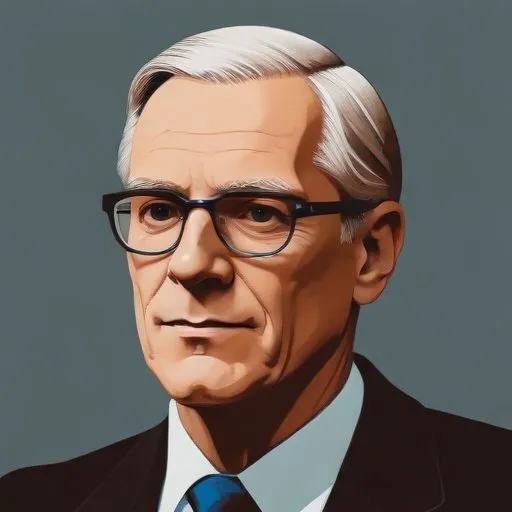
Developed groundbreaking cryptography techniques, including the Beurling cipher, and made significant contributions to harmonic analysis and complex analysis.
Arne Beurling, a renowned Swedish mathematician, is famously known for his extraordinary feat of single-handedly decrypting the German cipher machine Siemens and Halske T52, considered more complicated than the infamous Enigma machine, in a mere two weeks using only pen and paper.
This remarkable achievement in 1940 not only showcased Beurling's exceptional mathematical prowess but also significantly contributed to the Allied forces' efforts during World War II. His work on decrypting military telegrams between Norway and Germany remained effective until 1943, when the Germans changed their equipment.
Beurling was born on February 3, 1905, in Gothenburg, Sweden, to Konrad Beurling, a landowner, and Baroness Elsa Raab. He pursued his higher education at Uppsala University, where he earned his Bachelor of Arts degree in 1926 and Licentiate of Philosophy degree two years later.
Beurling's academic career was marked by several notable milestones. He served as an assistant teacher at Uppsala University from 1931 to 1933 and later became a docent of mathematics. In 1933, he received his doctorate in mathematics for his dissertation "Études sur un problème de majoration."
Beurling's work had a profound impact on harmonic analysis, complex analysis, and potential theory. His famous Beurling factorization led to a better understanding of the Wold decomposition and inspired further research on invariant subspaces of linear operators and operator algebras.
The T52, also known as the Geheimfernschreiber, was a secret teletypewriter used by Nazi Germany to send ciphered messages. Beurling's remarkable achievement in deciphering the T52's code was made possible by his exceptional mathematical skills and dedication.
This feat showcases Beurling's ability to think outside the box and apply mathematical concepts to real-world problems. His work not only contributed to the war effort but also paved the way for future cryptographers and codebreakers.
Beurling's contributions to mathematics and cryptography have left a lasting impact on the scientific community. His work continues to inspire new generations of mathematicians, cryptographers, and codebreakers.
In recognition of his outstanding contributions, Beurling was appointed as a professor of mathematics at the Institute for Advanced Study in Princeton, New Jersey, where he worked alongside other prominent mathematicians.
Despite his exceptional academic achievements, Beurling remained humble and dedicated to his craft. His love for mathematics was evident in his commitment to his work, and his remarkable achievements continue to inspire and motivate others.
Beurling's legacy extends beyond his academic accomplishments, serving as a testament to the power of human ingenuity, dedication, and perseverance.
Born in 1906
A French mathematician and academic who made significant contributions to number theory, algebraic geometry, and the development of modern mathematics, leaving a lasting impact on the field.
Born in 1882
A pioneering mathematician and physicist who revolutionized abstract algebra and made groundbreaking contributions to modern physics, particularly in the development of Einstein's theory of general relativity.
Born in 1854
A pioneer in mathematics and physics, he laid the foundations for modern chaos theory, topology, and relativity, making groundbreaking contributions to our understanding of space and time.
Born in 1862
A renowned mathematician and academic who developed infinite-dimensional vector spaces and laid the foundation for quantum mechanics and relativity. He's also famous for his 23 unsolved math problems that shaped 20th-century mathematics.
Born in 1903
Pioneering mathematician and physicist who developed the concept of the modern computer architecture and made significant contributions to quantum mechanics and game theory. His work laid the foundation for modern computing and artificial intelligence.
Born in 1906
A groundbreaking logician and philosopher who shook the foundations of mathematics with his incompleteness theorems, proving that no formal system can be both complete and consistent.
Born in 1917
A renowned mathematician who made significant contributions to number theory, particularly in the development of the Selberg trace formula, and was awarded the Fields Medal and the Abel Prize.
