


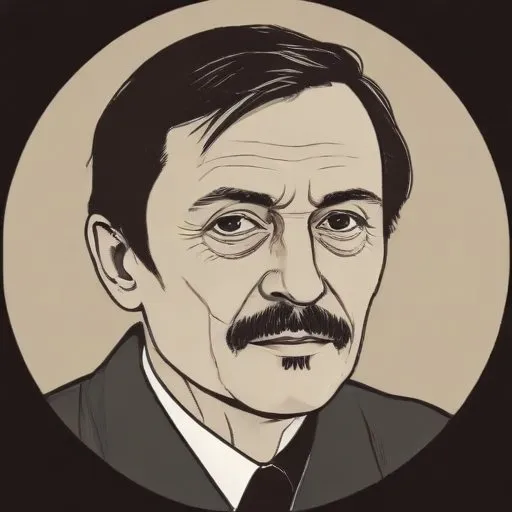
A renowned Russian poet and translator, celebrated for his lyrical and introspective works that explore the human condition, as well as his translations of prominent world literature.
Arseny Tarkovsky, a renowned Soviet and Russian poet, translator, and writer, left an indelible mark on the world of literature. He is perhaps best known for his remarkable translation work, which introduced Russian readers to the treasures of Arabic, Azerbaijani, Georgian, and Armenian poetry.
Tarkovsky was born on June 25, 1907, in Yelisavetgrad, Kherson Governorate, Russian Empire (now Kropyvnytskyi, Ukraine). His father, Oleksandr Tarkovsky, was a public figure and writer of Polish noble origin, who was repressed by the Soviets under a court case of Ukrainian socialists. Arseny's mother, Maria Danilovna Rachkovskaya, came from a family of intellectuals.
Tarkovsky's early life was steeped in literature and music. He attended the Elisavetgrad gymnasium and studied at the music school of Gustav Neuhaus, father of the famous musician Heinrich Neuhaus. As a child, he would often attend poetry evenings with his father and brother, where they would meet celebrated poets like Igor Severyanin, Konstantin Balmont, and Fedor Sologub.
In 1924, Tarkovsky moved to Moscow and began working for the newspaper Gudok, where he managed an editorial section written in verse. He later studied literature at a university college in Moscow, and it was during this period that he developed a passion for translating poetry from various languages. His translations of Abul-Ala-Al-Ma'arri, Nizami, and other Arabic and Persian poets are still widely read today.
During World War II, Tarkovsky volunteered as a war correspondent for the army newspaper Boevaya Trevoga. He was wounded in action in 1943 and suffered a severe leg injury that led to gas gangrene. Tarkovsky underwent six gradual amputations, but this did not deter him from his literary pursuits.
Tarkovsky's poetry and translations are characterized by a deep sense of humanity, empathy, and a quest for knowledge. His work often explores the complexities of human relationships, love, and social justice. He believed that literature had the power to transcend borders and bring people together, a philosophy that is reflected in his dedication to translating the works of poets from diverse cultures.
Arseny Tarkovsky's legacy extends far beyond his own literary achievements. He inspired a generation of writers, poets, and translators, and his work continues to be studied and admired by scholars and readers around the world. His son, Andrei Tarkovsky, went on to become a celebrated film director, and his granddaughter, Marina Tarkovskaya, is a poet and writer in her own right.
"Poetry is the language of the soul, and translation is the bridge that connects us across cultures and time."
Arsney Tarkovsky's unwavering commitment to his art, despite the challenges he faced, serves as a testament to the power of literature to inspire and uplift humanity.
94 Years Old
A visionary filmmaker who explored the human condition through poetic, visually stunning, and introspective movies that continue to inspire artists and audiences alike.
Born in 1898
A pioneer of montage editing, he revolutionized filmmaking with his iconic scenes and theories, influencing generations of directors.
Born in 1896
A pioneering filmmaker who experimented with documentary and narrative styles, known for his innovative and influential works that pushed the boundaries of cinematic storytelling.
Born in 1920
A renowned filmmaker who directed epic historical dramas, including a seven-hour adaptation of Tolstoy's "War and Peace" that won the Academy Award for Best Foreign Language Film.
Born in 1894
A pioneering filmmaker of Ukrainian origin, known for his poetic and visually stunning movies that often explored the human condition, particularly in the context of Soviet Ukraine.
