


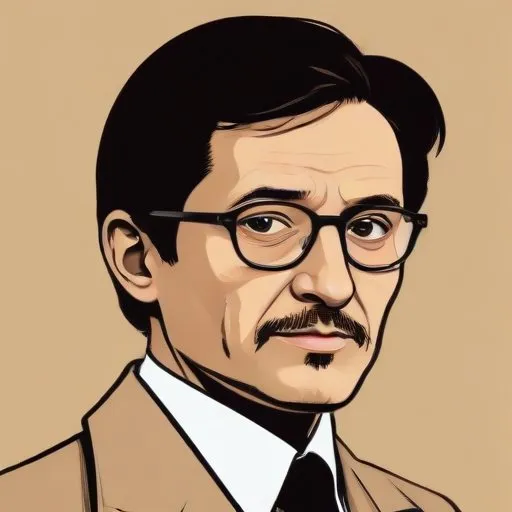
A prominent Russian music journalist and critic, known for his influential writings on rock music and its cultural significance in the Soviet Union.
Artemy Troitsky is a Russian journalist, music critic, concert promoter, radio host, and academic, best known for his pivotal role in shaping the Soviet rock scene and beyond. Dubbed the "leading Soviet rock critic" by The New York Times in 1988, Troitsky's influence extends far beyond the realm of music, influencing the cultural and social fabric of the Soviet Union.
Born on June 16, 1955, in Yaroslavl, Russia, Troitsky hails from a family of intellectuals. His father, Kiva Lvovich Maidanik, was a political scientist and Latin American historian, while his mother, Rufina Nikolaevna Troitskaya, was a scholar in her own right. Troitsky's early years were spent in Prague, where his parents worked for the journal Problems of Peace and Socialism. This exposure to international politics and culture would later shape his worldview and inform his writing.
Troitsky's foray into the music world began in the early 1970s, when he led discos at Moscow State University. This experience laid the groundwork for his future endeavors in music promotion and criticism. In 1977, he graduated from the Moscow Institute of Economics and Statistics with a degree in mathematics and economics.
From 1978 to 1983, Troitsky worked as a junior research fellow at the Institute of Art History, where he honed his critical skills and developed a keen eye for the intersection of music and culture. During this period, he also played guitar for the seminal Soviet rock band Zvuki Mu. This experience gave him a unique perspective on the music industry, allowing him to navigate the complexities of the Soviet rock scene with ease.
In 1986, Troitsky was instrumental in organizing the Account No. 904 rock concert, a pioneering event that raised funds for the victims of the Chernobyl disaster. Modeled on Live Aid, this concert marked a watershed moment in Soviet rock history, bringing together artists and musicians from across the Soviet Union.
In the 1990s, Troitsky turned his attention to academia, lecturing on music journalism at Moscow State University. He has since taught at various institutions, including the State University of Management, where he developed curricula on the history of the entertainment industry and music press.
Troitsky's influence extends beyond the classroom, with his writing and criticism continuing to shape the Russian music landscape. He has worked as a lecturer in Tallinn and Helsinki, spreading his knowledge and passion for music to a new generation of students and enthusiasts.
Artemy Troitsky's contributions to Soviet rock and beyond are immeasurable. As a critic, he championed the work of emerging artists, providing a platform for their voices to be heard. As a promoter, he brought together musicians and fans, creating a sense of community and solidarity in the face of adversity.
Today, Troitsky's legacy continues to inspire and influence a new generation of music enthusiasts and critics. His commitment to the principles of freedom and creativity has left an indelible mark on the cultural landscape of the Soviet Union and beyond.
This quote, uttered in a 2017 interview, distills the essence of Troitsky's philosophy, one that has guided his career and inspired countless others.
Troitsky's life is a testament to the power of music to transform and uplift. From his early days leading discos to his current role as a respected academic and critic, Troitsky has remained committed to the principles of creativity and freedom.
As we look back on his remarkable career, we are reminded of the enduring legacy of Soviet rock and the pivotal role that Artemy Troitsky played in shaping its trajectory. His influence continues to be felt, inspiring new generations of musicians, critics, and fans alike.
94 Years Old
A visionary filmmaker who explored the human condition through poetic, visually stunning, and introspective movies that continue to inspire artists and audiences alike.
Born in 1898
A pioneer of montage editing, he revolutionized filmmaking with his iconic scenes and theories, influencing generations of directors.
93 Years Old
A prominent Russian poet and playwright, known for his bold and provocative works that often critiqued Soviet politics and society, earning him both acclaim and controversy.
Born in 1924
A renowned Russian bard, known for his poignant lyrics and soothing melodies that captured the essence of Soviet life, inspiring generations of musicians and writers.
88 Years Old
A Russian cultural icon, renowned for his poignant, socially conscious songwriting and acting, which captured the essence of Soviet life and resonated with the masses.
86 Years Old
A Russian-American poet and essayist who won the Nobel Prize in Literature in 1987, known for his lyrical and introspective poetry that explores themes of identity, morality, and the human condition.
78 Years Old
A renowned Russian-American dancer, choreographer, and actor who revolutionized ballet with his athletic style and charismatic stage presence, starring in films like "The Turning Point" and "White Nights".
