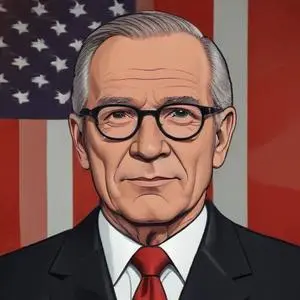
Arthur H. Vandenberg: The Unlikely Titan of American Politics
The Isolationist Turned Internationalist
Arthur Vandenberg is remembered as the unlikely champion of American internationalism, a man who underwent a dramatic transformation from ardent isolationist to pioneering internationalist. His remarkable shift in perspective, which occurred during his time as a U.S. Senator from Michigan, had a profound impact on American foreign policy and continues to shape global dynamics to this day.
A Biographical Sketch
Born on March 22, 1884, in Grand Rapids, Michigan, Vandenberg was the son of a newspaper editor and publisher. He followed in his father's footsteps, beginning his career as a journalist before entering politics. In 1928, he was elected to the U.S. Senate, where he served for 18 years, earning a reputation as a powerful and influential figure.
Early Isolationism and the Interwar Years
During the interwar period, Vandenberg was a staunch isolationist, opposing American involvement in international affairs. He believed that U.S. foreign policy should focus on protecting American interests at home, rather than entangling itself in European conflicts. This stance was reflected in his support for the Neutrality Acts of 1935 and 1936, which aimed to prevent American involvement in the escalating European crisis.
The Pearl Harbor Epiphany
However, the Japanese attack on Pearl Harbor in 1941 marked a turning point in Vandenberg's life and politics. He realized that American isolationism was no longer tenable in the face of global threats. This epiphany led him to reassess his views on international relations, and he began to advocate for a more active American role in world affairs.
Vandenberg's Internationalist Conversion
Vandenberg's conversion to internationalism was cemented in 1945, when he played a key role in shaping the United Nations Charter. He worked closely with President
Harry S. Truman, Secretary of State
James F. Byrnes, and other international leaders to create a framework for global cooperation and diplomacy. This collaboration marked a significant shift in Vandenberg's politics, as he came to recognize the importance of collective security and international cooperation.
The Vandenberg Resolution and Bipartisanship
In 1948, Vandenberg introduced the Vandenberg Resolution, a landmark legislative initiative that authorized the President to negotiate a collective defense treaty with European nations. This resolution laid the groundwork for the North Atlantic Treaty Organization (NATO), cementing Vandenberg's legacy as a champion of international cooperation. The resolution also demonstrated Vandenberg's commitment to bipartisanship, as he worked closely with Democrats and Republicans to pass the legislation.
Legacy and Impact
Arthur Vandenberg's transformation from isolationist to internationalist had far-reaching consequences for American foreign policy. His leadership in shaping the UN Charter and NATO helped establish the United States as a global leader, and his commitment to bipartisanship paved the way for future diplomatic efforts. Vandenberg's legacy serves as a testament to the power of political courage and the importance of adapting to changing global circumstances.
- Vandenberg was awarded the Presidential Medal of Freedom in 1947 for his contributions to international cooperation.
- He was a strong advocate for the Marshall Plan, which aimed to rebuild post-war Europe.
- Vandenberg's personal papers are housed at the Bentley Historical Library at the University of Michigan, providing valuable insights into his life and politics.
Personal Milestones and Key Life Events
- Vandenberg married Elizabeth Watson in 1906, and they had three children together.
- He was a member of the Republican Party and served as the Chairman of the Senate Republican Conference from 1945 to 1947.
- Vandenberg suffered from poor health throughout his life, including a bout of tuberculosis in his youth.
Quotes and Memorable Sayings
- "We must not be isolationists, but we must not be internationalists merely for the sake of being internationalists."
- "The time has come when we must take our rightful place among the nations of the world, not as a reluctant and hesitant giant, but as a confident and courageous leader."
Historical Context and Legacy
Arthur Vandenberg's life and politics were shaped by the tumultuous events of the 20th century. His transformation from isolationist to internationalist reflects the evolution of American foreign policy during this period. Vandenberg's legacy continues to influence global diplomacy, serving as a testament to the power of political leadership and the importance of adapting to changing global circumstances.
FAQ
What was Arthur H. Vandenbergs role in American politics?
Arthur H. Vandenberg was an American journalist and politician who served as a US Senator from Michigan from 1928 to 1951. He was a prominent figure in the Republican Party and played a key role in shaping US foreign policy.
What was Arthur H. Vandenbergs stance on foreign policy?
Arthur H. Vandenberg was a strong supporter of international cooperation and collective security. He played a key role in the development of the United Nations and was a vocal advocate for American involvement in international organizations.
What was Arthur H. Vandenbergs relationship with President Truman?
Arthur H. Vandenberg had a close relationship with President Harry S. Truman, despite being from different parties. He worked closely with Truman to develop the Truman Doctrine and the Marshall Plan.
What was Arthur H. Vandenbergs most notable achievement?
Arthur H. Vandenbergs most notable achievement was his role in the development of the United Nations. He was a key player in the Senates ratification of the UN Charter and was a strong advocate for American participation in the organization.
What was Arthur H. Vandenbergs legacy?
Arthur H. Vandenbergs legacy is one of bipartisan cooperation and international cooperation. He will always be remembered as a statesman who put the interests of the country above party politics.