


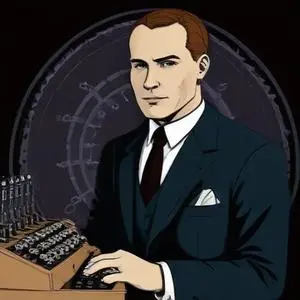
A German electrical engineer who invented the Enigma machine, a complex electro-mechanical cipher machine used for secure communication during World War II. This invention revolutionized cryptography and had a significant impact on the war's outcome.
Arthur Scherbius, a German electrical engineer, is renowned for inventing the mechanical cipher Enigma machine, a groundbreaking innovation that revolutionized cryptography and left an indelible mark on modern history. This ingenious device, patented and sold under the brand name Enigma, offered unparalleled opportunities for secure communication, transforming the landscape of military and civil intelligence.
Born on October 30, 1878, in Frankfurt am Main, Germany, Scherbius grew up with a passion for electrical engineering. He pursued his studies at the Technical University Munich and later at the Leibniz University Hannover, where he completed his dissertation, "Proposal for the Construction of an Indirect Water Turbine Governor," in 1903, earning his doctorate in engineering (Dr. Eng.).
Scherbius' professional journey was marked by stints at various electrical firms in Germany and Switzerland. In 1918, he founded the firm Scherbius & Ritter, where he developed several groundbreaking inventions, including asynchronous motors, electric pillows, and ceramic heating parts. His research contributions led to the recognition of the Scherbius principle for asynchronous motors.
In 1918, Scherbius filed a patent for a cipher machine based on rotating wired wheels, which would later become known as the rotor machine. His initial design, Model A, was a bulky device, weighing around 50 kg. Subsequent models, B and C, were more portable and featured lamps to indicate the encrypted letters. Scherbius named his invention Enigma, the Greek word for riddle, reflecting the machine's incredible complexity.
The military Enigma machine, featuring three rotors from a set of five, each with 26 positions, and a plug board with ten pairs of connected letters, boasted an astonishing 158,962,555,217,826,360,000 possible settings – nearly 159 quintillion combinations. This mind-boggling complexity made it extremely challenging to decipher, earning the Enigma machine its reputation as one of the most secure encryption devices in history.
Arthur Scherbius' invention of the Enigma machine has had a profound impact on the world of cryptography, intelligence, and warfare. His pioneering work paved the way for advanced encryption techniques, influencing modern cryptography and inspiring future generations of cryptographers and engineers. Scherbius' legacy serves as a testament to human ingenuity and innovation, reminding us that the pursuit of knowledge and creativity can lead to groundbreaking achievements that change the course of history.
Arthur Scherbius' remarkable life and achievements serve as a beacon of inspiration, reminding us of the power of human imagination and innovation to shape the world and leave a lasting legacy.
Born in 1906
A British mathematician and computer scientist who played a crucial role in cracking the German Enigma code during World War II, and later wrote about his experiences.
Born in 1917
Noted baseball player and scout who played for several teams and later discovered talented players like Lou Brock and Lee Smith. Known for his keen eye for talent and contributions to the game.
Born in 1917
A brilliant codebreaker and coin enthusiast who helped crack the German Enigma code during WWII, making significant contributions to Allied victory.
