


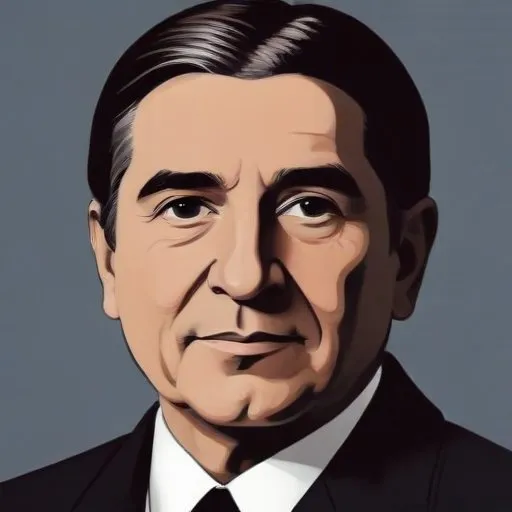
Lawyer and politician who served as President of Argentina from 1958 to 1962, known for his efforts to modernize the country's economy and infrastructure. He also established diplomatic relations with the Soviet Union, a significant move during the Cold War era.
Arturo Frondizi, a luminary in Argentine politics, is renowned for his visionary leadership as the President of Argentina from 1958 to 1962. During his tenure, he championed a developmentalist approach, prioritizing industrial growth and oil policy reforms that continue to shape the country's economic landscape.
Born on October 28, 1908, in Paso de los Libres, Corrientes, Argentina, Frondizi was an accomplished lawyer, journalist, teacher, and politician. His dedication to public service was evident from a young age, as he actively participated in the Argentine Radical Civic Union (UCR) and later co-founded the Intransigent Radical Civic Union (UCRI) in 1957.
Frondizi's presidency was marked by a significant shift towards developmentalism, a doctrine that emphasized state-led economic growth and industrialization. He surrounded himself with influential advisors, including Rogelio Frigerio, who played a crucial role in shaping his economic policies. Under Frondizi's leadership, Argentina witnessed the establishment of multinational companies, which contributed to the development of heavy industry.
Frondizi's government faced intense opposition from labor and student movements, who contested his policies on oil and education. The period was marked by widespread demonstrations, strikes, and violent clashes, resulting in the loss of 17 lives. Despite the turbulence, Frondizi remained committed to his developmentalist agenda.
In 1962, a military coup brought an abrupt end to Frondizi's presidency, and he was detained for 18 months without trial. This event had a profound impact on Argentine politics, paving the way for future military interventions. Frondizi continued to be involved in politics, supporting the 1966 military coup that ousted President Arturo Illia. However, he soon realized the mistake and distanced himself from the new regime.
Arturo Frondizi passed away on April 18, 1995, at the age of 86, leaving behind a complex legacy. His commitment to industrialization and economic growth remains a subject of debate among historians and economists. Nevertheless, his vision for Argentina's development continues to influence the country's political and economic landscape.
Arturo Frondizi's legacy serves as a reminder of the complexities of Argentine politics and the enduring impact of visionary leadership on a nation's development.
Born in 1895
The authoritarian leader who ruled Argentina with his charismatic wife Eva, implementing populist economic policies and promoting nationalism, while suppressing opposition and civil liberties.
Born in 1919
A former actress who used her charisma and influence to advocate for women's suffrage and workers' rights, becoming a beloved and powerful figure in Argentine politics.
99 Years Old
The first democratically elected president of Argentina after a period of military rule, known for his efforts to promote human rights and democracy in the country.
96 Years Old
The 50th President of Argentina, a lawyer-turned-politician who implemented neoliberal economic policies and pardoned military officers involved in human rights abuses during the country's Dirty War. He's also known for his flamboyant style and corruption scandals.
76 Years Old
The 51st President of Argentina, who served from 2003 to 2007, is known for his efforts to rebuild the country's economy and restore its international reputation after a severe crisis. He's also recognized for his human rights advocacy and social welfare programs.
73 Years Old
The first female President of Argentina, serving from 2007 to 2015, known for her progressive policies and strong leadership during a period of economic growth. She later became Vice President, continuing to shape the country's politics.
67 Years Old
The first democratically elected non-Peronist president of Argentina, who implemented market-friendly reforms and led the country out of recession. He's known for his efforts to stabilize the economy and promote foreign investment.
Born in 1778
Led the successful fight for independence in Argentina, Chile, and Peru, and is revered as a national hero in these countries. He's also credited with creating the Army of the Andes, a crucial force in the Latin American wars of independence.
