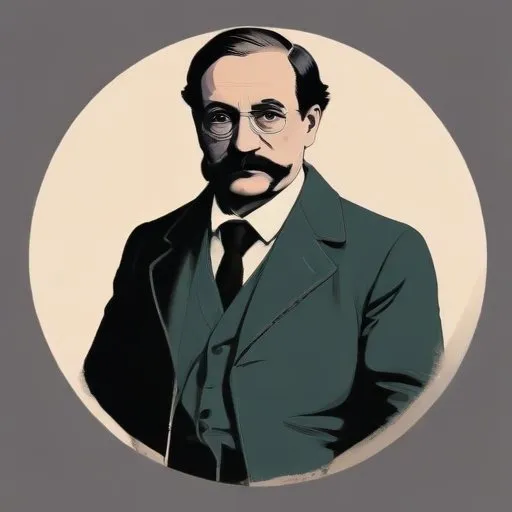
August Weismann

August Weismann

August Weismann was born on January 17th, 1834

Full Name: August Friedrich Leopold Weismann
Profession: Biologist, Zoologist, and Geneticist
Nationality: German
Notable Work: The Germ-Plasm Theory
Born: January 17, 1834
Died: November 5, 1914
Field of Study: Evolutionary biology
Theory: Germ plasm theory

A pioneering geneticist who discovered the germ plasm theory, proposing that hereditary information is transmitted through germ cells, and developed the concept of genetic continuity. He also disproved the theory of Lamarckian inheritance.

Written by: Lisa Chang Lisa Chang

August Weismann: The Pioneer of Germ Plasm Theory

A Legacy in Evolutionary Biology

August Weismann, a renowned German evolutionary biologist, is celebrated for his groundbreaking germ plasm theory, which revolutionized the understanding of inheritance and heredity in multicellular organisms. This theory, also known as Weismannism, posits that inheritance occurs solely through the transmission of germ cells, such as egg and sperm cells, and not through somatic cells, which make up the rest of the body.

Early Life and Education

August Friedrich Leopold Weismann was born on January 17, 1834, in Frankfurt am Main, Germany. He pursued his higher education at the University of Göttingen, where he earned his Ph.D. in zoology in 1856. Weismann's academic journey was marked by a series of prestigious appointments, including his role as the Director of the Zoological Institute and the first Professor of Zoology at Freiburg.

The Germ Plasm Theory and Its Impact

Contributions to Evolutionary Biology

Weismann's work not only refuted Lamarckism but also emphasized the importance of a variable environment in driving variation in hereditary material. He was a strong advocate for the role of mutation as the primary source of genetic variation, which is acted upon by natural selection.

Influence on Modern Biology

Weismann's ideas had a profound impact on the development of modern evolutionary biology. His work influenced prominent biologists, including Ernst Mayr, who ranked Weismann as the second most notable evolutionary theorist of the 19th century, after Charles Darwin.

Awards and Honors

Legacy and Impact on Modern Society

Weismann's germ plasm theory has far-reaching implications for our understanding of evolutionary processes, genetic inheritance, and the natural world. His work has inspired generations of biologists, shaping our understanding of the intricate relationships between organisms and their environments.

In conclusion, August Weismann's pioneering work in evolutionary biology has left an indelible mark on the scientific community. His germ plasm theory continues to influence our understanding of the natural world, and his legacy serves as a testament to the power of human curiosity and intellectual inquiry.

Timeline
1834
Born in Frankfurt, Germany
August Weismann was born on January 17, 1834, in Frankfurt, Germany, to a family of modest means. He would later become a renowned biologist and geneticist.
1856
Studied Biology in Göttingen
Weismann studied biology in Göttingen, where he was tutored by some of the greatest biologists of the time. This marked the beginning of his scientific career.
1863
Discovered the Germ Plasm Theory
Weismann discovered the Germ Plasm Theory, which proposed that heredity is determined by the transmission of genetic material from one generation to the next.
1885
Published The Germ Plasm
Weismann published his seminal work, The Germ Plasm, which detailed his Germ Plasm Theory and cemented his reputation as a pioneer in the field of genetics.
1914
Died in Freiburg, Germany
August Weismann passed away on November 5, 1914, in Freiburg, Germany, leaving behind a legacy of groundbreaking scientific research and discovery.
August Weismann

August Weismann Quiz

What is the main concept proposed by August Weismann's germ plasm theory?

Score: 0/5
FAQ
What is August Weismanns most significant contribution to biology?
August Weismann is best known for his theory of germ plasm, which proposes that genetic information is passed down from generation to generation through the germ cells. This theory fundamentally changed the understanding of heredity and evolution.
How did August Weismanns work challenge the concept of Lamarckism?
August Weismanns work challenged the concept of Lamarckism, which suggests that acquired traits can be inherited. Weismanns experiments and theories demonstrated that genetic information is fixed and cannot be influenced by environmental factors.
What was August Weismanns role in the development of modern genetics?
August Weismann played a crucial role in the development of modern genetics, laying the foundation for later researchers such as Gregor Mendel and Charles Darwin. His work on heredity and evolution continues to influence the field of genetics today.
What were August Weismanns research methods?
August Weismanns research methods involved experimenting with Hydra, a small freshwater animal, to study the process of regeneration and the role of germ cells in heredity. His experiments were groundbreaking and helped establish him as a leading figure in the field of biology.
How did August Weismanns work impact the understanding of evolution?
August Weismanns work significantly impacted the understanding of evolution, providing evidence for the theory of natural selection and the concept of gradualism. His research helped establish evolution as a fundamental principle of biology.

Related People:

Charles Darwin

Born in 1809

Developed the theory of evolution through natural selection, revolutionizing our understanding of life on Earth. This groundbreaking idea transformed the fields of biology, ecology, and beyond.

Gregor Mendel

Born in 1822

An Austrian monk who pioneered genetics by experimenting with pea plants, discovering the fundamental laws of heredity, and laying the foundation for modern genetics.

Jean-Baptiste Lamarck

Born in 1744

A French soldier, biologist, and academic who developed a theory of inheritance of acquired characteristics, proposing that organisms adapt to their environment and pass on those traits to their offspring.

Ernst Haeckel

Born in 1834

A German biologist, physician, and philosopher who coined the term "ecology" and made significant contributions to the field of evolutionary biology, including the recapitulation theory.

Hugo de Vries

Born in 1848

A Dutch pioneer in genetics, he discovered mutations and introduced the concept of genes, laying the foundation for modern genetics. His work influenced the development of evolutionary theory.